 Products









Ready to get started?
No matter where you are on your CMS journey, we're here to help. Want more info or to see Glide Publishing Platform in action? We got you.
Book a demoA court ruling in Germany has held Google liable for erroneous answers provided by AI Overviews - is this a precedent that changes the game?
What is meant by transformative in a commercial sense? Your pigs into my hams certainly means I'd be responsible for the quality or not of the ham. "It's not bad ham madam, it's bad pigs" doesn't cut the mustard, does it?
How about the tin used to create plasma in the delicate process of producing 3nm chips in a ultraviolet photolithography machine? If Tim's Tin Company doesn't supply the requisite grade of tin, and the photolithography machine ends up producing silicon lego bricks, whose fault is that? The people running the machine and not checking their tin, obviously.
Well, what of LLMs? Currently, the consensus is that they operate at around 90 per cent accuracy. One in ten of the results they return are flawed to one degree or another. This is something users are expected to be aware of (they often aren't) and must take in account when using one.
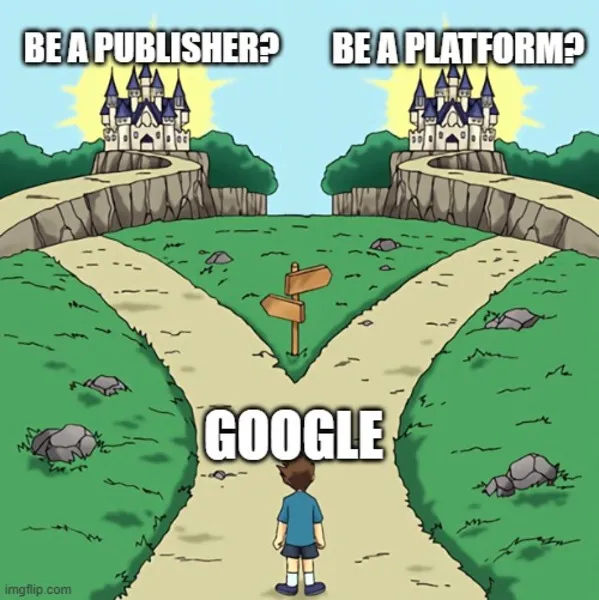
Over to Germany, specifically a court in Munich, which in the past few weeks has ruled that Google is liable for false claims in the answers its LLM returns and could signal an end to Google's traditional shield of "we're a platform not a publisher".
The case that saw the court bring legal scrutiny to bear on the matter actually involved two actual publishers, to add insult to injury. Answers provided by Google's AI Overviews had falsely linked the publishers to scams and dubious business practices such as subscription traps, which is obviously a commercial death sentence for the online presence of any business.
The Regional Court of Munich found that Google could not employ a "fair use" defence in the case. In Germany, as in most jurisdictions, search engines are not liable for the results they produce, yet the court ruled that AI Overviews are something quite different to that - they produce "independent, new, and substantive statements" in Google’s own words, so that Google is ultimately responsible for what is produced by them. The court identified the false claims as "the defendant’s own statements".
In other words, they can't blame the pigs.
Importantly, the Munich court ruled that the links displayed by Google in this case did not support the claims made by AI Overviews. That is to say, if the process of verification that an LLM search user is expected to make by checking the sources against the answer was undertaken, then the links did not support the provided answer - an AI "hallucination" as they have been called. It's thought that something like one per cent of users actually check sources. The advertised and constantly promoted omniscience of such systems sits uneasily with their actual accuracy, but you can't blame people for believing the hype.
We need to reiterate our general position on AI here, lest we be seen as technological naysayers. AI systems clearly have great utility and potential. When used in a manner that allows for their performance parameters, they can be a useful and flexible tool. It's not a question of being for or against them, rather one of judging on merits.
Google plans to appeal the ruling. "This case focuses on specific and narrow errors, not the foundational way AI Overviews displays web content. We disagree with the ruling and plan to appeal," a Google spokesperson told Reuters.
There's an important fork in logic here, admittedly in different legal areas. One is that content produced by LLMs is "transformative", meaning it is so differentiated from the content used in training the systems that it is a thing in its own right. This is obviously an argument that has been deployed in LLM copyright disputes.
This position seems to be contrary to what Google would like the courts to think in the above case, where the answer is not owned by them and they are not liable for such erroneous results.
The legal framework regarding such technology is still being constructed, in fits and starts. It is to be hoped that the rigorous logic employed in the Munich case becomes a feature of that process.
After two decades of having their cake and eating it, and our cake too, such changes may mean Google has to start deciding which it wants to be, publisher or platform. It can't be both.
No matter where you are on your CMS journey, we're here to help. Want more info or to see Glide Publishing Platform in action? We got you.
Book a demo
