 Products









Ready to get started?
No matter where you are on your CMS journey, we're here to help. Want more info or to see Glide Publishing Platform in action? We got you.
Book a demoBy parachuting an ex-UK political heavy into the role of global negotiator-diplomat, OpenAI seems intent on reshaping its corporate face outside the USA. And where pragmatism prevails, so do deals.
Three types of consumables are required in order to launch a commercially scaled AI business: hardware, power, and content. Money is another of course, but since that seems to grow on trees for AI companies lets concern ourselves only with the three which are in more limited supply.
The first two elements in the trio are, currently, expensive. Witness the price spike warnings of DRAM memory chips vital to seas of everyday systems and devices. Steep rises in cost mean that, while AI is promised to speed up your life, its hunger for chips means the actual devices and machines we use everyday are doomed to be stuck in slow mode, or get even slower.
We read of 8GB becoming an enforced standard limit in laptops, and increasing numbers of smartphones with only 4GB where they were a decade ago. PC gamers have their heads in their mouse-shaped hands and the fact the machine this article is being written on features a giddy 32GB of RAM basically makes me a silicon Ferrari owner.
Power and energy costs we know about too, with even an energy-independent superstate as the USA facing a reckoning on the scale of investment required to power AI’s processing demands, similarly de-watting local energy networks to boot. Can you please turn your lights down - think of the AI! It’s like the Covid pan-banging for medics, but to keep Mark Zuckerberg in jets and underground bunkers.
The final pillar of this trinity is content, because devoid of training data, your godlike AI is merely a probabilistic temple without a faith.
Despite many reasons for medium-term optimism about transactional relationships being formed between those who produce content and those who want it for AI transformation, the landscape is still populated with distrust, dispute, and outright theft.
With the squeeze on power and hardware being the real bottom-line bummers for the ambitious AI sector, we are clearly in a situation where not having to pay for training data is still attractive to some, and so the motive to continue looting material as they find it remains extant.
A friend on the inside, but to whom?
With the relationship conventions between those who produce content and those who want it being in flux, the rules of the game will be defined by the actions and conduct of the largest players such as OpenAI.
So it would seem desirable that there is a new voice within earshot of the OpenAI top table who has - shock! - actually worked in the media, and values it. A former newspaper editor perhaps?
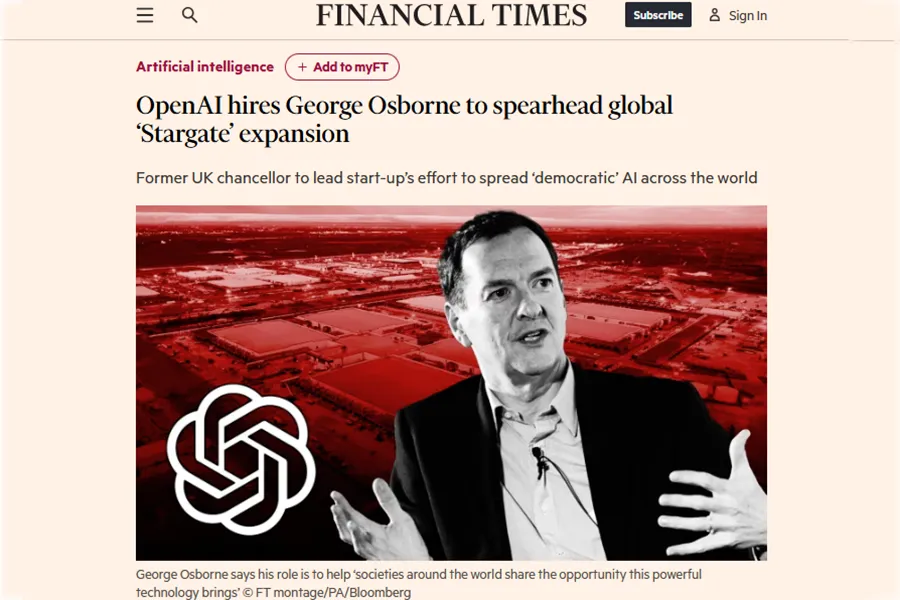
Step forward one George Osborne, famously the former editor of the London Evening Standard - an actual newspaper and the UK capital’s largest dedicated publication - and who is now OpenAI’s nebulously branded Head of OpenAI for Countries.
This new division will spearhead OpenAI’s Stargate plan to build data centres and state-level customer bases around the world and “all of OpenAI’s work deploying AI with overseas governments, spanning from developing infrastructure to using the technology for education and training”.
While this sounds like easy meat for any modern editor, we suspect his appointment stems from one of Osborne’s many other jobs past and present, specifically as, err... the UK Chancellor of the Exchequer, the most powerful role after the Prime Minister, insider at global political gatherings for years, and the man at the economic wheel when Brexit happened.
He’s not the first UK politician to head down this route. Nick Clegg, formerly leader of the UK’s third party and deputy PM, spent nearly 7 years as Facebook’s VP of Global Affairs and Communications after leaving office, and former PM Rishi Sunak has recently joined Microsoft and Anthropic as an advisor.
“OpenAI for Countries” isn’t the most promising department title, but let’s be honest none of them are being hired for their vibe coding skills. They are being hired for their contacts books, and a level of geographic determinism with experience of the UK’s age old role as interlocutor between the US and Europe, having deep bonds to both.
So, what can all this mean for media and publishing, and content creators and rights owners, if anything? Quite recently, Clegg came down on the side of the content bandits, favouring the unpopular “opt out” model of content scraping as opposed to a permission-based system; he was roundly criticised for it. It’s easy to go native in that tech world, it appears.
In this case I don’t believe Osborne is such a pliable creature as Clegg. In effect, he is taking on a role something like a papal nuncio, working for a business currently sustained more by belief than financial reality, and suggesting that OpenAI is starting to value pragmatism, diplomacy, and experience at the suprapolitical level more than just the ability to pump LinkedIn posts and soundbites for investor decks.
Osborne’s experience with the media must count for something: he has been both on the receiving end of political newsgathering, and in on the newsgathering operation itself and thus surely knows the value of content, and - as chair of the board of the British Museum - of cultural treasures too.
As a man who once set tax rates for a nation, Osborne should know better than most how economic incentives work. While I know his role is to accelerate OpenAI’s throatgrab of new markets before rivals, we hope he can get the message over that the simplest way to dampen opposition to content theft and secure a vital resource before your rivals is to simply pay for it. As we have seen elsewhere, if OpenAI does not pay it will fall behind others who do.
Compared to DRAM, nuclear power stations, and politicians, talk and text is cheap. Pay up.
No matter where you are on your CMS journey, we're here to help. Want more info or to see Glide Publishing Platform in action? We got you.
Book a demo
