 Products






Ready to get started?
No matter where you are on your CMS journey, we're here to help. Want more info or to see Glide Publishing Platform in action? We got you.
Book a demoMost publishers have audience data scattered across systems that don't talk to each other. Glide Nexa connects identity, engagement, entitlements, access, and first-party data in one platform, tying every interaction back to a single known user.
Publishers typically collect audience data in more places than they realise - email platforms can know who opens mails, registration walls can know who logs in, subscription systems can know who pays, and analytics can know what people read or like.
The problem is that these systems don’t know that it's all one person, they leave it to your data or audiences teams to try and work it out. And that can be slow and expensive - if it’s even possible.
Each of these tools can hold a fragment of the audience picture, but without something to connect it all together, publishers end up with multiple dashboards, multiple data silos, and no unified view of who their audience actually is or what they care about.
This is the gap that Glide Nexa fills. It is an Audience Interaction Platform which sits between a publisher’s content and their audience,and brings identity management, engagement tracking, personal preferences, paid or unpaid entitlements, and first-party data collection, all in one place. It connects tools publishers already use, or in some cases can fully replace them, around a single, known user.
As an audience interaction platform, Nexa does not fall into the neat but narrow category of identity management or subscription management, because it does much more than that.
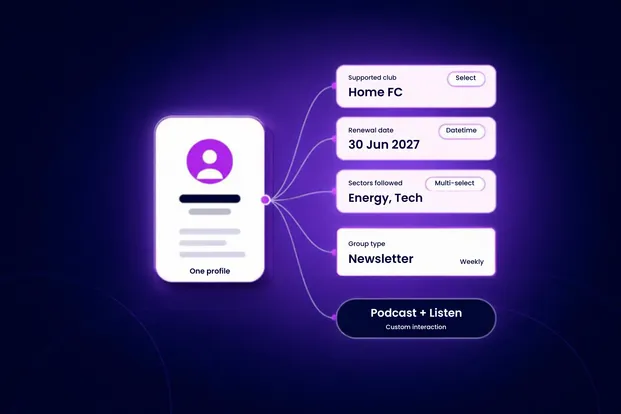
A reader who logs in, follows a few topics, saves some articles to their profile, takes part in a poll or survey, and subscribes to a premium tier or content bundle, generates a very rich and connected profile.
Every action is tied to the same user, updated in real time, and owned entirely by the publisher. Without Nexa, achieving this typically means stitching together multiple point solutions, such as an identity provider, a subscription management tool, a payment provider, and a data warehouse, and building something special at the centre of it all to connect them. Each system held part of the picture, and if you made your own "hub" to see it all you are now responsible for the upkeep and development of that key system.
Nexa removes that responsibility. It is delivered as SaaS, always maintained and always optimised, with new features arriving as they're developed. The same model as Glide CMS: no infrastructure to manage, no upgrade cycles to plan around, and no additional cost when new capabilities ship. Pricing is designed around the same principle. Most audience platforms charge per registered user, which means costs rise in lockstep with growth, exactly when publishers should be benefiting from scale rather than paying more for it.
Nexa's pricing model keeps recurring user-related costs to an absolute minimum, so growing a registered audience base builds commercial value rather than eroding it.
Nexa consolidates all of those requirements and goals into one single platform. Its configurable capabilities which you can control include:
These aren’t separate modules bolted together, they’re all one system where identity, behaviour, access,and analytics all reference the same user.
Nexa works as the identity and data layer at the centre of a publisher’s audience-facing stack. It doesn’t replace every tool a publisher uses, it connects the ones you already use, or means you don’t even need some of them.
The connected tools vary by publisher, but the pattern is consistent: email platforms pull identity and preferences from Nexa, commenting systems tie posts to known users, polls and games log participation against real profiles, and payment providers sync entitlement data. Analytics can flow in the other direction too, feeding behavioural signals back into Nexa for richer segmentation.
Nexa ties all of these to a single user profile, creating a consolidated view of audience behaviour that no single tool can provide on its own without significant expense and commitment to build something to fill the gaps.
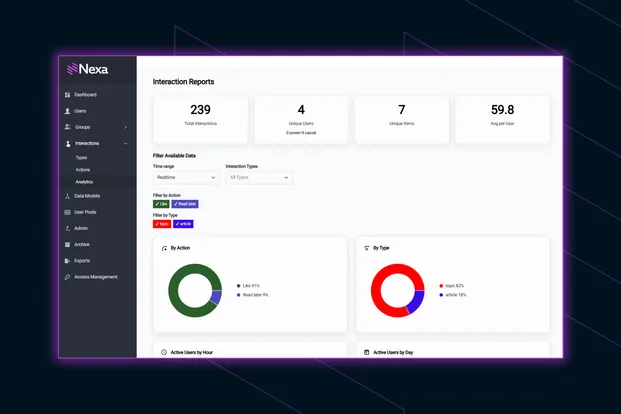
Commercially, this is very important. When your ad sales team says “our audience is highly engaged”, now claims can be backed up with cross-channel evidence from a single source. When your subscriptions team wants to identify readers most likely to convert, they can take a look and Nexa will show interaction patterns across every touchpoint.
Commercial teams, ad sales, and editorial can all use Nexa for the data they need, and that shared visibility is what turns engagement from an editorial metric to a commercial asset.
Every piece of data in Nexa is first-party, collected on the publisher’s platform, tied to authenticated users, and fully owned by the publisher.
With third-party cookies disappearing, social referral traffic declining, and platform algorithms doing their own thing, publishers who built audience understanding on third-party data are watching the old foundations erode.
That’s where Nexa provides an alternative: build your audience knowledge on your own platform, through your own interactions, tied to your own authenticated users. There is no dependency on external platforms who also want that data, and no risk of that data disappearing when browser policies change or a platform adjusts its API terms.
Data exports are configurable in CSV, JSON, and XLSx formats, with field selection and permission-controlled access. Publishers can pull what they need for external systems, reporting, or advertising partnerships, while maintaining full control over what’s shared with whom.
Nexa deploys independently from any CMS. A publisher that is using Wordpress, a bespoke CMS, or any other platform can deploy Nexa as their audience layer. The API-first architecture means it connects to any front-end or back-system.
That being said, Nexa and Glide CMS of course work together naturally. Content Tags in Glide CMS can drive personalisation rules in Nexa, while Glide Verify uses Nexa’s entitlement data for content gating.
For publishers already on Glide CMS, Nexa extends the platform even further, from content management into audience management. For publishers using other systems, Nexa provides the audience layer without requiring a CMS migration.
We think Nexa and Glide work together beautifully for publishers starting fresh, without the need to embark on a shopping spree of multiple platforms and tools, or the need to worry about multiple data stores and archives being accessed by said new tools.
Nexa provides enough built-in capabilities on day one to get going without being a full audience stack. Starting with identity at the centre means every tool added later connects naturally. A commenting system added in month three ties back to the same user profiles, while a polls feature added in month six generates interaction data against the same known readers. It’s a gradual build up, without a series of resets and blind spots caused by spreading your buying decisions over time. Nexa brings the advantage of starting with the hub rather than forcing it into existence later.
If you're stitching together multiple tools to get a unified view of your audience, or you're not there yet, we'd like to show you how Nexa works. Request a demo with a Glide product specialist.
Related articles:
No matter where you are on your CMS journey, we're here to help. Want more info or to see Glide Publishing Platform in action? We got you.
Book a demo
