 Products







Ready to get started?
No matter where you are on your CMS journey, we're here to help. Want more info or to see Glide Publishing Platform in action? We got you.
Book a demoWhile initially taking a "scorched earth" policy position on copyright and AI, the British Government has come to its senses. It just doesn't know what its senses are now.

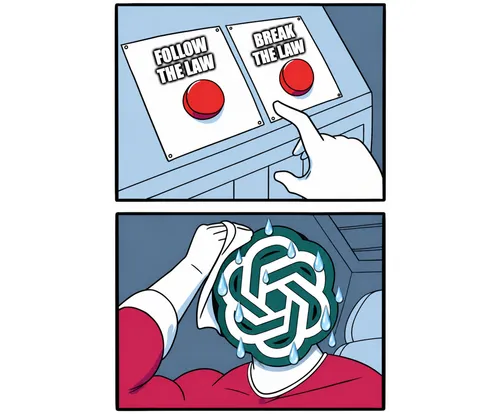
Having previously recommended driving a coach-and-horses through the very notion of copyright in order to serve the ends of Big AI, the UK Government has sobered up and this week delivered a document that has, using far too many words and bringing far too little substance, at least made it clear that, for the moment, a careless and destructive hand is stayed from the UK's creative industries.
To quickly recap, the initial suggested Government position on copyright and AI use was to bring in an "opt-out" policy - meaning the original creative material was presumed to be available for use as AI training data unless the owner otherwise specified.
How exactly this was ever to be achieved - or even could it be achieved - was never set out, and it all had the promise of the kind of online copyright anarchy that only benefits one party. In this case, the party taking other people's work for free to be turned into wealth for themselves.
The UK's creative industries deserve a great deal of credit for making the government see just how unpopular this notion was. In public responses to the official consultation undertaken by the Department of Culture, Media and Sport, the overwhelming number of responses - 95% in fact - were in favour of actually strengthening current copyright law.
There were a number of campaigns from the music industry, featuring heavyweight luminaries such as Sir Paul McCartney and Sir Elton John, and well as strong efforts from the publishing and visual arts industries. It meant the public campaigns had a concerted element to them, and when you're up against both the glittering and the false promises of Big AI, concerted effort is what is required.
The upshot of all this, as revealed in the official report, is that the Government have, in many words and with much detail about their thinking, decided to wait and see what happens. You can read the ministerial statement from Liz Kendall, the Secretary of State of Science, Innovation and Technology here.
In reality, while the creative industries have won this battle, they have not won the war. There is a clearly a powerful lobby in the Government which is friendly to Big AI that must be contended with, and they have not gone away. I say Big AI purposely. A perfect illustration of the dilemma a national government finds itself when contending with a global situation, with global players, is shown by the response to the consultation from Tech UK, representing the UK technology sector, noting "that partnerships between AI developers and content holders have been growing, but that their smaller members noted challenges accessing data at scale under the status quo."
That means the home-grown little guys can't get a look in when it comes to accessing the amount of data Big AI has. This is not a situation conducive to growing a domestic UK AI industry base which is presumably what they are trying to do.
As Ed Newton-Rex, chief executive of Fairly Trained, told The Times: "The government’s dropping of its hugely unpopular 'preferred option' is certainly welcome. But it is still explicitly considering weakening copyright law to benefit AI companies, which would be a catastrophic error of judgment. It should stand up for the UK’s creatives and rule out handing their work to big tech companies."
It's telling that the report concedes that, "over 70 cases involving copyright have reportedly commenced before the USA courts, most involving fair use ... the outcome of these cases will have consequences not only in the USA, but in the UK and around the world."
It's certainly realistic to concede that the US may become some kind of legal template for the UK, if only because the mainly US AI giants will have to comply with it. Yet, right now, leaving all UK options "on the table" as the current generation of politicians likes to say, is simply a recipe for continued uncertainty.
For example, one potential form of copyright exception mooted by the government is for a loosely defined "research exception". This is presumably to enable research institutions to access data without paying for it. However, upon hearing it, my mind instantly conjured up the image of a Japanese whaling ship "researching" whales by harpooning and eviscerating them.
There is another element to all of this, and this is the belief that by simply using the magic combination of the letters A and I, our political elite seek to bask in the reflected glory and promise of progress, even as a multitude of more prosaic matters require urgent attention, such as how to power the AI in the first place.
No matter where you are on your CMS journey, we're here to help. Want more info or to see Glide Publishing Platform in action? We got you.
Book a demo
