 Products






Ready to get started?
No matter where you are on your CMS journey, we're here to help. Want more info or to see Glide Publishing Platform in action? We got you.
Book a demoStrategic internationalization needs more than multilingual content. From workflow management to SEO and content and monetization architecture, Glide CMS gives publishers - international and those with international aspirations - the tools to scale their operations without losing control.

What is internationalization in publishing? Internationalization (i18n) is the strategic work beneath multilingual and market-specific content adatopion - the architecture, workflows and business decisions that turn multilingual capability into a scalable intertional operation.
In the first article of our internationalization series, we looked at the practical challenges of multilingual content management and delivery and how Glide CMS tackles language support, right-to-left interfaces, instant translations, and local audio with accents and dialects, and we touched upon localizations and locale-specific routing. The nuts and bolts of getting content published in multiple languages by multiple teams.
But as we noted then, language and multilingual content support is just one piece of the internationalization puzzle. A well-thought-out international publishing operation means rethinking your entire content operation.
Briefly put, internationalization (i18n) is the strategic framework beneath your multilingual and market-specific content adaptation. This article focuses on the internationalization framework that makes it all possible - the architecture, the workflows, and the business decisions that turn multilingual capability into a truly international success story - without it being too expensive to run and the usual worries and chaos caused by system inefficiencies.
When audience signals suggest demand exists in other markets, and you have the resources to do it properly, going international sounds brilliant - new audiences, new revenue streams, nice upward graphs. But it can often throw up obstacles spanning strategic, operational, and technical domains and teams.
These aren’t just one-and-done business decisions; it’s a constantly shifting set of priorities as your target markets evolve.
Then workflow complexity starts multiplying. Regional teams need their own approval processes and have different editorial priorities. Managing this takes serious structure and a thoughtful system that’s not getting in the way.
Content architecture is usually the make or break of international aspirations. What content should be shared across markets? What needs creating specifically for regions? How do you structure templates and taxonomies when some things need to be global and others hyper-local? If you're monetizing content, how does that work per region? Do pieces in different markets relate to each other somehow? The questions pile up fast, and the answers aren't always obvious.
SEO and UX in particular need attention so that your content isn’t just sitting around, unfound. Search engines need to index things correctly, and users need consistent experiences regardless of their location. URL structures, metadata, technical implementation - miss any of it, and you’re practically invisible in markets you’re trying to crack.
On top of all of this is audience targeting, which means understanding that what works in London might fall flat in Tokyo. Tone, imagery, cultural references, and even article structure may need adjusting to resonate with your local and international audiences. No forcing square pegs into round holes.
And much, much more… This is why so many publishing teams back away from internationalization, even when they know it’s leaving serious revenue on the table. Without a system that can actually support all these moving parts, it feels overwhelming.
Glide CMS was built for international publishing from the ground up. We’ve designed the system to handle these challenges efficiently, giving publishers a sophisticated internationalization toolset without the usual operational nightmares.
Your internationalized content and sites should be as commercially appealing to local partners and advertisers as content that was produced locally from the start.
This isn't about adding a few extra dollars or euros or yen as a nice bonus. We’re talking about a genuine new revenue stream, a proper business unit. Glide CMS lets you build that at a fraction of the cost and time you'd need to set up an actual local team and infrastructure from scratch.
Structuring teams for international operations
Effective internationalization starts with how you structure content and team operations. It’s not merely about having the multilingual publishing capability, but the sturdy system workflows that allow the UK editor to work as efficiently as the editor logging into the system from Seoul.
Glide CMS provides granular control over regions and teams. You can assign specific editors and workflows to particular locales or regions, and these regional teams see only what's relevant to them - their content, their priorities, their workflows, their markets. Meanwhile, leadership maintains oversight across everything, with full visibility when they need it, while development teams get access to the full system for all the technical work.
It goes beyond simply hiding irrelevant content from view. It's about creating focused work environments where teams can actually operate efficiently without distractions from other markets they're not responsible for. When your Madrid editor doesn’t have to scroll past hundreds of UK articles to find their own content, or accidentally publish to the wrong locale because the interface was confusing.
Taxonomies for multilingual publishing
In Glide CMS, hierarchical taxonomy structure is the bread and butter of content architecture. Taxonomies are fundamental to how content flows through your system, how it gets discovered, and how it reaches audiences across markets.
Taxonomies also sit at the heart of Glide CMS’s internationalization approach. They are super easy to localize (with the right permissions!) while sharing the same underlying ID as the original taxonomy and avoiding unnecessary duplication.
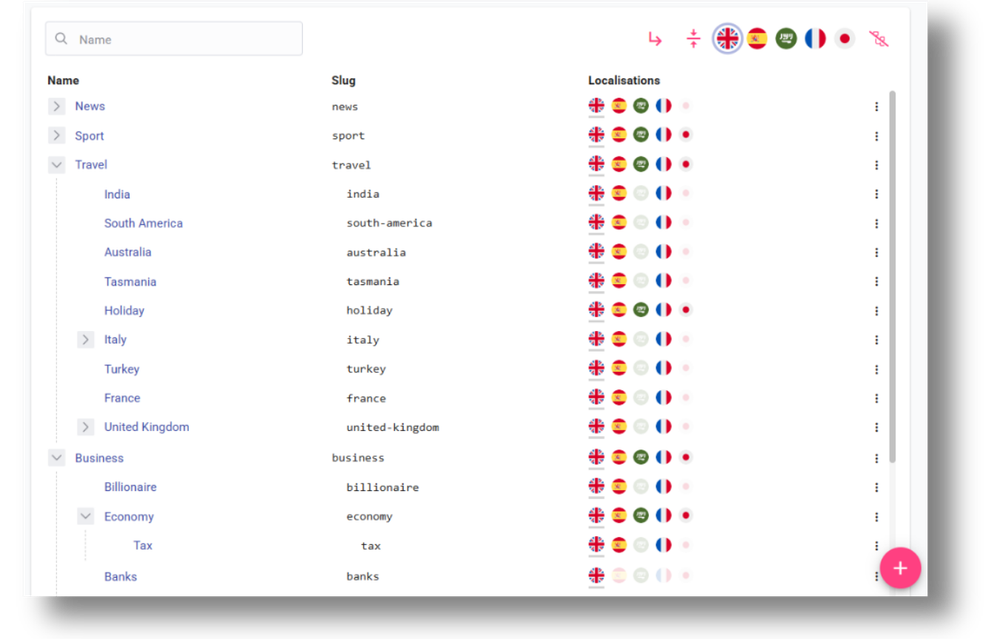
Sample taxonomy structure in Glide CMS, showing localisation coverage across each taxonomy term.
In practice, this means that you can have "football" in English and "fútbol" in Spanish, both pointing to the same taxonomy structure. You're not maintaining separate, disconnected taxonomy systems for each market, but one logical structure that presents appropriately per locale.
Glide CMS actually enforces this properly. Say you’re localizing a UK article for Spanish publication, but the original article categorized under “football’’ doesn’t yet have a Spanish localized taxonomy. The system will not let you immediately publish; it will warn you that the taxonomy doesn’t exist for that particular locale. It keeps you in check, preventing you from publishing Spanish content under English categorization, and enforces proper taxonomy hygiene across markets rather than creating a mess you’ll regret later.
Long and short of it: get your taxonomy structure right, and everything else becomes considerably easier - content organization, workflow routing, SEO optimization, audience targeting. It's the foundation that supports everything else.
One story, many markets: shared, adapted, and regional content
Reading experiences obviously differ dramatically across cultures and markets, but this affects just about everything in how you approach international publishing. It isn't rocket science, but many systems make it unnecessarily difficult. Your CMS should accommodate that reality rather than fighting it at every turn.
Whether you’re dealing with shared content that works across markets with minimal changes, or adapted content - same football match, different angles for different fanbases - or completely regional content only relevant in specific markets, Glide CMS lets you manage all three approaches without making everything harder than it needs to be.
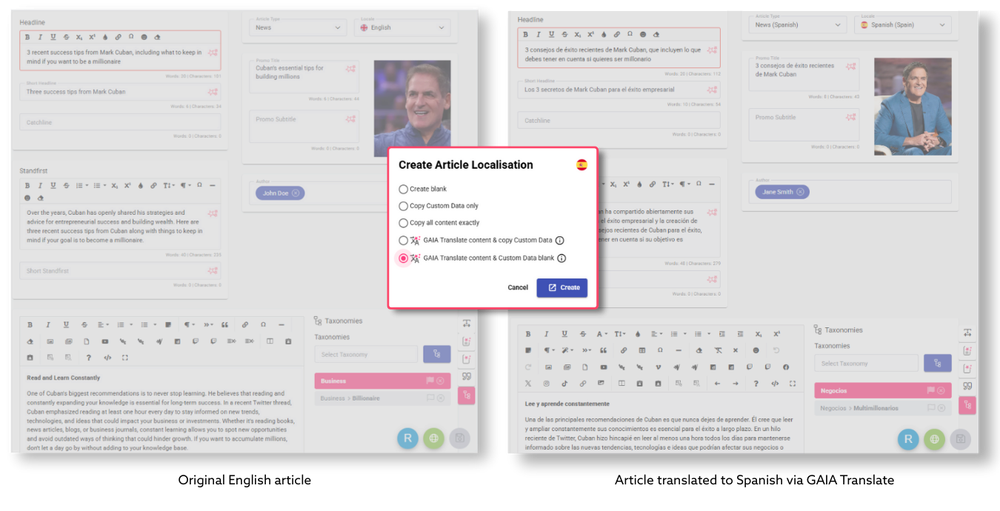
GAIA-translated article in Glide CMS, showing the original English version alongside the Spanish localisation, with localised taxonomies and a different article type applied for Spanish.
Editors can easily create a related piece that shares core elements - perhaps the same event, quotes, or underlying facts - whilst tailoring headline, tone, imagery, and angle to what matters locally. These pieces are still managed as distinct content items with their own life cycles, workflows, and monetization strategies.
We covered translation and text-to-speech in the first article in this series, Going global without the chaos: Multilingual content done right with Glide CMS - GAIA Translate for instant in-CMS translations with human review, GAIA Voice for audio versions with local accents and dialects - so we won't spend too much time on that here. Suffice to say they feed into the broader internationalization toolkit, giving you speed without sacrificing editorial control. Journalists and editors still need that human touch before hitting publish.
Even the strongest content and creative work will fall flat if audiences can't actually find it or enjoy reading it once they do. And discoverability and usability rely on several interconnected features working together.
Launching new markets, fast with locales and hreflang
Adding a new market is a matter of adding a new locale in the existing system, not setting up a new infrastructure. With over 100 preconfigured locale options, Glide CMS supports global-to-local orchestration, custom locale creation, and inheritance mechanisms for precise control. Hreflang tags (HTML attributes that tell search engines like Google which language and regional versions of a page exist), custom metadata per market - it can all be managed directly within the CMS.
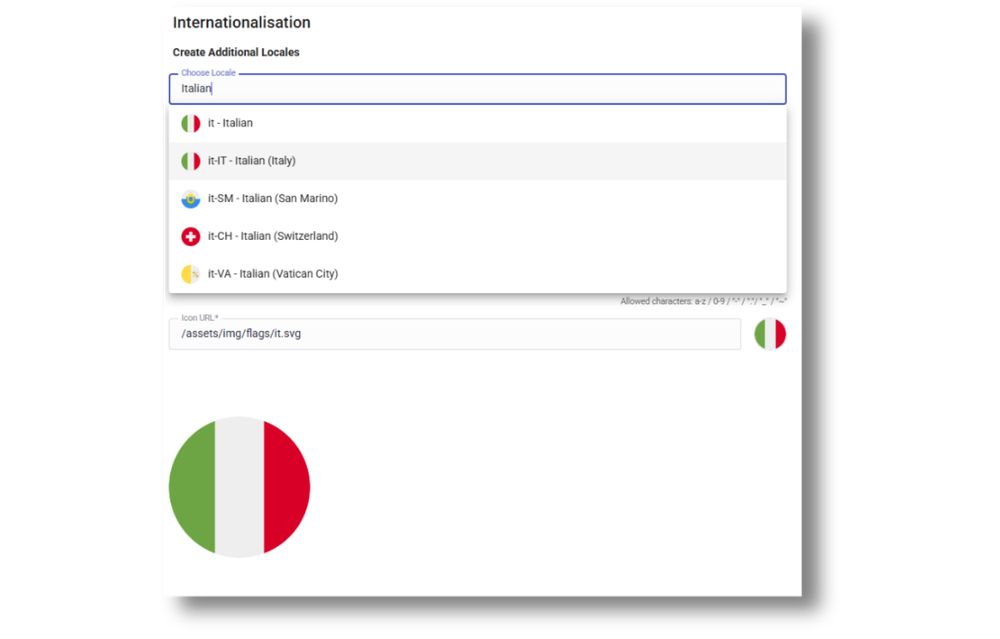
Locale creation in Glide CMS, using Italian as an example to illustrate out-of-the-box language and regional variants.
Defining routing and pages for new locales becomes a configuration exercise and a speed run - this can be set up in hours rather than months of custom development projects.
Flexible templates for regional expectations
Different markets have different presentation expectations, and your CMS should let you meet them without rebuilding infrastructure every time.
Glide CMS allows flexible site templates and layouts to serve different regions effectively, reflecting regional branding, UX preferences and compliance requirements. Your UK site can look wildly different from your Japanese site, both different from your Arabic site, all managed from the same CMS. And template inheritance means you’re not building from scratch for every market. You can easily define the base templates, and then extend and customise per locale.
Market-aware content modelling
Local format support matters. Australian audiences reviewing or buying a product off your website don’t care about the cost in US dollars. This support for local formats may extend to dates, numbers, currency, and measurement units - which are all configurable in Glide CMS through custom fields or content modelling, without making you look careless of your audiences, where small details matter when building trust.
Or maybe your sports coverage needs different structured data for football vs soccer - which, depending on where your audience is, are either the same or two completely different sports. Custom fields, which can vary per content type, handle this without forcing you into a one-size-fits-all model that doesn’t match audience expectations.
All of this is configurable by your team, and your regional editors can work within structures that make sense to them and the audiences they are writing for without waiting on developers to build custom solutions from scratch.
Monetizing contenta cross international markets
The bit that actually keeps publishers in business: making money from international audiences - and where many stumble because the CMS can’t handle the complexity.
Glide CMS’s content tagging system gives you granular control over which audiences can access specific articles, parts of an article, or complete site sections. Together with our content gating service, Glide Verify, and any paywall provider of your choosing, you can easily execute your monetization strategies.
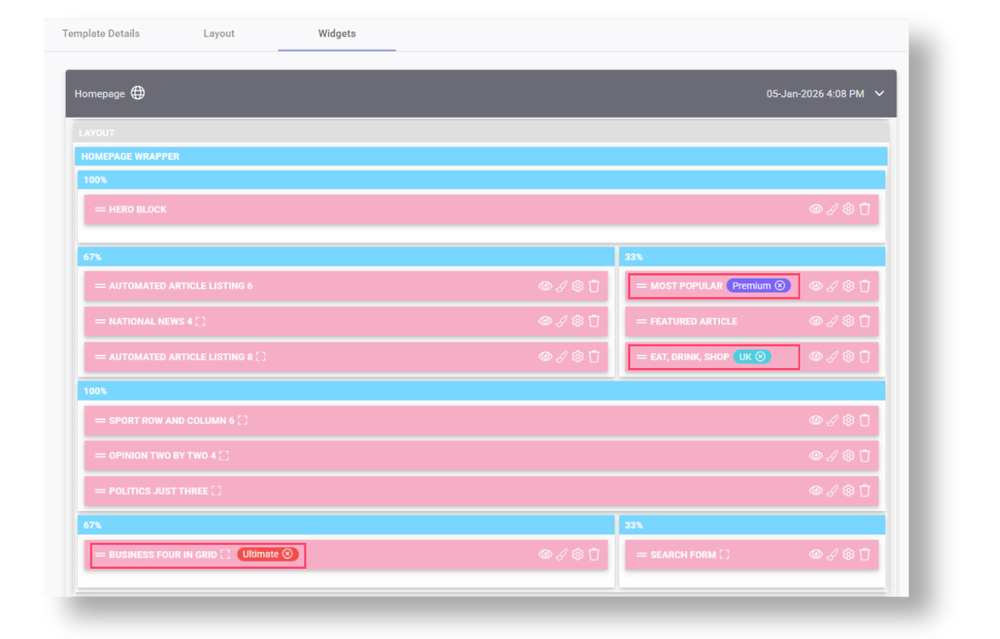
Widget-level content tagging in Glide CMS, applied within templates to support monetisation and geo-targeting.
Maybe your UK audiences pay a premium subscription to access certain financial content, but the very same content is free in all other markets where you are still building trust. Or you may want to apply some geotargeting strategies to a singular article where your Spanish audiences will read only one paragraph differently from your French audiences. The options are vast.
What matters is that Glide CMS puts editorial teams in full control of this, not just your development team. Editors can apply these content tags as they see fit, and your commercial teams can adjust monetization strategies without waiting on technical implementation, giving your organization flexibility to iterate quickly in a way most CMSs cannot.
All of the above can run through a single CMS workflow, and publishers can easily manage multiple locales from one central platform while avoiding juggling disconnected systems and partial decisions.
Editors see different things based on their permissions, but it’s the same underlying platform. You’re not exporting from one system and importing into another one. Content adaptations maintain relationships between pieces per market. Glide CMS is your one place where content lives and workflows happen, which in turn makes it easier to train and onboard new staff with clearer accountability throughout.
For organizations that do require separation, Glide offers a multi-tenant model where you can use independent Glide accounts for different websites while still leveraging the shared infrastructure model, but each tenant maintains its own workflows, templates, rules, permissions, everything.
But what does Glide CMS’s internationalization framework actually mean in practice for publishers eyeing international expansion?
Faster publishing, fewer constraints
Disconnected systems create duplication and inefficiency and bring unwanted business risk. Teams waste time copying content between platforms, pieces aren’t linked, translations get lost in email chains, and mistakes easily happen at the cost of quality.
One CMS for all languages and regions enables faster content delivery, cleaner workflows, and a single source of truth. Editorial teams spend time creating and refining content rather than wrestling with infrastructure and trying to keep multiple systems in sync.
Better audience engagement
Maintaining consistent quality and brand voice across international markets proves difficult when content feels like an afterthought translation rather than a considered adaptation.
Glide CMS allows for better audience engagement through tailored experiences that feel native to each market whilst remaining recognizably part of your brand, with proper workflows in place for adaptation rather than just translation. Readers stick around longer and convert at higher rates when content speaks directly to them.
Easy to scale
Scaling editorial operations across languages and regions hits walls quickly. Systems that work for two markets groan under the weight of five - UK, US and Australia seem manageable, but as soon as you add Spain and Italy, everything starts breaking, and even talking about Japan feels impossible.
Scalable, flexible architecture supporting future expansion means you’re not locked into painful migrations or expensive rebuilds every time you want to add a new market. Glide CMS makes it easy to add new markets as opportunities arise rather than waiting until technology finally catches up.
Internationalization is a strategic priority for publishers serious about growth, but only if it’s done properly. Often these decisions can force speed over structure and just create more technical debt, and a failed attempt hanging over everyone’s heads becomes a cautionary tale haunting the whole organisation.
Cutting corners in laying the foundation just means you’ll pay for it later, with interest. Eventually you will need to rebuild, which costs more than doing it right the first time.
Glide CMS was designed to support publishers across markets, languages, and cultures. Our internationalization toolset provides the sophisticated capabilities publishers need for true international success while keeping workflows and teams productive and focused, whether you’re just taking your first steps beyond the home market or already managing dozens of markets across continents.
Read our first article in the series to learn more about Glide CMS’s multilingual capabilities: Going global without the chaos: Multilingual content done right with Glide CMS
To learn more about how Glide CMS can support your international publishing strategy, or to see the platform in action, connect with a Glide product specialist
What is the difference between translation and localization? Translation converst text from one language to another; localization adapts the whole experience - tone, imagery, formats (dates, currency, units), taxonomies and article angle - so content feels native to each market. Glide CMS supports adatpion, not just translation.
What are hreflang tags and why do they matter for international publishing? Hreflang tags are HTML attributes that tell search engines which language and regional versions of a page exist, so the right version is served to the right audience. In Glide CMS, hreflang and custom per-market metadata are managed directly in the CMS.
How fast can you launch a new market in Glide CMS? Adding a market means adding a locale in the existing system rather than buliding new infrastructure. With 100+ preconfigured locales, routing and pages can be set up in hours rather than months.
Can editors control monetization per market without developers? Yes. Glide CMS's content tagging, the Glide Verify gating service, and your chosen paywall let editorial and commercial teams apply access rules and geotargeting per article or section without waiting on development.
Related articles:
No matter where you are on your CMS journey, we're here to help. Want more info or to see Glide Publishing Platform in action? We got you.
Book a demo
