 Products









Ready to get started?
No matter where you are on your CMS journey, we're here to help. Want more info or to see Glide Publishing Platform in action? We got you.
Book a demoTimes duo's legendary night, better ad rates for publishers, Meta's blind eye to scams, and "slop" '25 - all in this week's Content Aware.

Corbidge comments... on OpenAI's latest hiring
If you want to play at boardroom level, you hire people with experience of the boardroom world. So what does it say when OpenAI follows the lead of other tech rivals and starts hiring people from national and global politics? The company has moved its eyelines upwards to Government deals around the world, bringing in a notable UK political figure to help. Our Abacus of Accountability Rob looks at what OpenAI's new hire could mean for media and rights holders.
Read
Pay up or stay out
News publishers are fighting back against AI grabbers with the help of a tool called Really Simple Licensing (RSL). Think of it as robots.txt on steroids, giving publishers control over their content, how it’s used, and where it shows up in search - all with the nice addition of being able to demand payment for its use. It’s already backed by 1,500 media organisations worldwide, including Yahoo!, Associated Press, and People Inc. RSL will funnel credit and cash back to creators, and most importantly, control over their own content. In the AI-first internet, publishers might finally get a say.
Read
AI theft by extension
Are your team’s Chrome Extensions gobbling up your (and their) data and chat, and sending it to brokers? Eight million business and personal installs of a family of popular “official” privacy-centric extensions from the Chrome and Edge stores harvested months of full AI chat sessions from the most-used AI services, selling chats and data, or perhaps worse. The extra sneaky bit? The ‘safe’ auto-update policy of official Chrome extensions meant the spying snuck into place without ever triggering alerts or warnings, let alone a user acceptance step. This article outlines the background, and offers good advice to mitigate fallout. Edge users were also affected according to the study.
Read
Bringing order to online chaos
The Associated Press has rolled out AP Verify, a new all-in-one verification dashboard which tells misinformation “not today”, and available to other organisations. It helps newsrooms find out what’s real and what’s been digitally modified, blending AI smarts with old-school verification muscle, to help separate legit content from internet nonsense. Tools such as geolocation sleuthing, reverse image searches, and object and landmark spotting are all part of a web-based hub. Coming as AP’s answer to the viral chaos of online news it is already battle tested across their global coverage. A handy tool of unglamorous tech which echoes the theme of the day that trust is there to be earned, and here is a way to do it better.
Read
Times duo domination
The Times and The Sunday Times are clearly doing something right (not just in choosing Glide...!) as they cleaned up at the recent Press Gazette British Journalism Awards. They snagged four big wins: Campaign of the Year, The Business, Finance, and Economics Journalism Award, Comment Journalism, and The Sports Journalism Award. As a proud CMS provider, big congratulations from us all at Glide!
Read
Spam vs Google: who’s winning?
Google is seemingly losing its grip when it comes to search quality, as spam is on the rise yet again sponsored by AI-generated content, expired domains, and PBNs. In a world where cash and attention is poured into expensive AI search experiments, is core spam-fighting turning into collateral damage? Harry Clarkson-Bennett discusses further.
Read
Newsroom ructions
The Washington Post learned the hard way that AI doesn’t play by any rules. Its new AI-generated podcast product quickly became a newsroom enemy after throwing out errors, opinions, fabricated quotes, and unsanctioned commentary. Woops. Journalists waved red flags and questioned how it happened, and although leadership acknowledged issues, it’s not a good look for any title and not the first time AI content direct-to-audiences has backfired.
Read
The content guardians
The Coalition for Content Provenance and Authenticity (C2PA) is aiming to become the digital footprint police of the AI era, as their framework slips metadata onto content to track where it has come from, who made it, and who edited it. While it’s a helpful tool, it won’t fact-check data for you, that’s still your job. Thanks to blockers such as tech hurdles, privacy concerns, and platforms loving to strip metadata tags like it’s confetti, the adoption of the framework has been slow but fret not, help arrived. C2PA and Google’s watermarking wizardry tool, SynthID, are tag teaming the issue and making content trustworthy again.
Read
AI ambitions gone wrong
Adobe just splashed into hot waters, as a proposed lawsuit claims its SlimLM model learned from pirated books thanks to a dataset called SlimPajama. With this, Adobe has joined other tech giants like Apple, Salesforce, and Anthropic, who all seem to have the same idea of using copyrighted content. They might get away with it in the moment, but there is always a lawsuit looming behind the corner.
Read
No ID, no problem
Louisiana just received a federal court smackdown. In NetChoice v Murrill, a law asking for government IDs to simply browse online has been ejected. Judge de Gravelles labelled it as vague, unconstitutional, and overreaching, and in breach of the First Amendment. After Ohio and Kansas, this is the third win for NetChoice, and it sends a very clear message: parental control aren’t being replaced by government checkpoints, and online privacy isn’t optional.
Read
Clickbait, code, and con artists
The internet’s reputation is low for a good reason. AI-generated scams, deepfakes, and tricks are becoming prevalent to see (if not fall for) which all end up causing real harm to users. It doesn’t help that all the tech giants such as X, Meta, and Google are dialling down on fact-checking and moderation, leaving users to fend for themselves. But, it is not all bleak. Researchers, lawmakers, and fact-checkers are stepping up, crafting new rules and studying misinformation to try and save the internet from becoming a digital Mad Max movie. Poynter has more tips on how to save the internet.
Read
Google loosens the grip
After six years of one-size-for-all pricing rules, Google is loosening its grip on its ad monopoly to try and soothe lawmakers before a potential break-up ruling. Publishers can now set different prices for different bidders in Google Ad Manager, a move coming after a antitrust slaps in the US and EU which include a €2.95bn fine for favouring its own adtech.
Read
What Meta doesn’t want you to know
What do you do when you have a hefty chunk of ad revenue linked to scams? You create a team that’s going to handle and remedy the issue, correct? Well according to Meta, that approach is the way to go unless the clean-up starts hurting the bottom line. After learning 19% of its China-linked revenue came from scams, illegal gambling, and other banned stuff, Meta created a task force, slashed the fraudulent ads, and saw huge improvements - until revenue losses saw them shelve most of the efforts, whence scams income rocketed again.
Read
Getty’s second shot at AI
The Court of Appeal has just given Getty Images the green light to have another go at Stability AI. The issue is with the meaning of “infringing copy”, whether it needs to exist inside an AI model and whether it is enough to be copyright infringement if done in the UK. Granted. This entails a court rethinking the very meaning of the word “copy”, and has revived interest in the case for its potential fallout further afield.
Read
Smart sounding ≠ smart
Although LLM AIs may sound smart, their philosophy is more about remixing word patterns and pure coincidence than reasoning. Gary Marcus discusses research on “semantic leakage” and how easily LLMs can be biased or derailed, which raises a sea of red flags.
Read
Slop takes the crown
Even Merriam-Webster has had enough. The dictionary has crowned the word “slop” as the 2025 Word of the Year, sending a not-so-subtle jab at the wave of AI-generated and low-effort junk clogging basically everything, from search and timelines to inboxes.
Read
We often hear at Content Aware and Glide that authenticity is key to modem content! In an age of AI slopbotomies, the only way to show you are real is to wear your blood-beating heart on your sleeve and go all in on the things that make you unmistakably human, like overeating at the end of year, mismatched socks, and shaking your fists at people using other forms of transport. At least that’s what our intern Chad G. Petey tells us, and he’s young and hip.
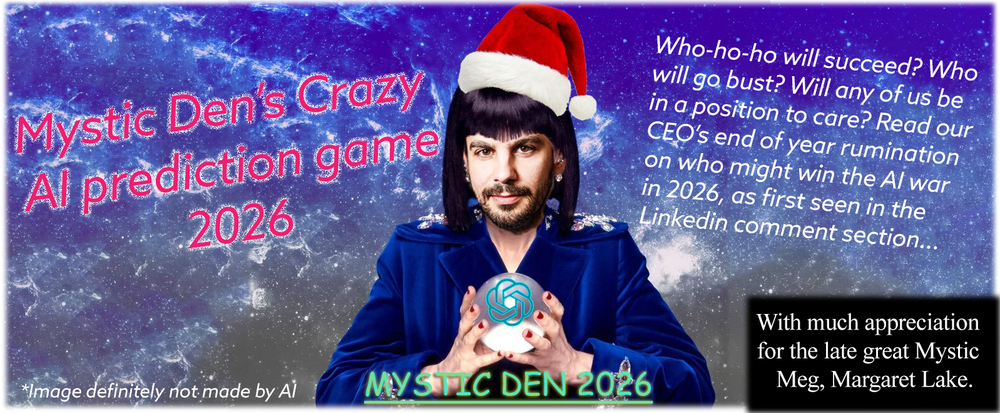
What better way to see the year out than to homage the great tradition of newspapers and be lectured by the bosses on what they think about the key subject of the day - AI - for the year ahead?!
After a year of publishing predictions and media mesmerism by our fortune telling Falstaff of Content Rob Corbidge, it’s rightly time to poll his rarely heard colleague Denis “Glide CEO” Haman on the great AI survival debate. In we go...
“There is no universe in which OpenAI doesn’t end up like Lycos. Thank you for tuning into my Ted talk.”
This proclamation was prompted by news that OpenAI must raise at least $200bn by 2030, in order to stay afloat just so it can continue to lose money. Written by a human at the Financial Times, that line is why I am optimistic about our industry of media and publishing despite the choppy waters we experienced in 2025.
🔹Beyond the noise, I foresee Amazon, Google, Microsoft, Meta & a couple of Chinese companies including Alibaba as the ones left standing because:
They can afford the AI budgeting arms race with the money they already have without having to sell the kidneys of every employee
They already have access to content and a content pipeline - stolen or otherwise
They have their own chips, or the capability to make them, and their own data centres
🔹LLM train-vs-gain attractiveness will peak and cease to matter for most users, for whom AI becomes just a feature inside other apps and devices. People don’t care who supplies the CRM for their apps (or the CMS for their content!) – AI will go the same way.
🔹EU AIs will – struggle. America will continue to lead the AI conversation at the global level, chased on price and capability by Chinese rivals which are already happening scooping market share in real world consumer use.
🔹Hallucinations and unpredictability will remain: it is a feature not a bug. There is no human-level AGI based on the technology which has got us here: you cannot finetune an LLM into being a totem for a person.
🔹OpenAI lost $12,000,000,000 in the last quarter. $12 billion, equivalent to 12,658 millennia of a premium digital subscription to the FT. That’s at today’s rates anyway - our friends at the FT subscriptions department may respond to inflation by the 100,000th Century!
🔹Following the Uber model, AI survivors will end subsidised usage once the market is cornered and users start to pay real prices – plus any gouging required for investors. $3 for a silly 10s video doesn’t scale for B2C, and B2B where the real money is will only be able to sustain cost rises for so long, given that outside of the world of AI, realworld businesses are facing realworld challenges from their consumers. A lot needs to go right for it to pay off, while much can go wrong - as Coca Cola found out.
🔹All this means AI will have to be objectively useful, and be actually worth paying for. A good example will be AI assisted coding, where assisted is the operative word.
🔹Companies going all in on AI workflows under board pressure might become trapped: unpicking a full AI workflow could be financially destructive, while at the same time being tied to the revenue models of AI firms recouping historic debt - risking a “frog-boiling” enshittification a la Google Search.
🔹Google and Meta will need to defend their remaining ad empires from collapsing under the weight of AI slop by finding a way to get quality content into play, and new business models for publishers will emerge which mean we can all breathe a sigh of relief if it means we can put the era of clickslop behind us too.
Am I mad? Tell me what you think below!
One thing I am certain of: it is on us to chase audiences rather than clicks - which is what we have always excelled at.
Happy 2025, and see you next year...
Mystic Den
And that’s a wrap!
As another year draws to an end, and we dim the lights and unplug the microwave at Glide Towers, we send you all our best wishes and hopes for all the possible ways the next year can outdo this one in good fortune for you all. See you in ‘26.
Team Glide.
No matter where you are on your CMS journey, we're here to help. Want more info or to see Glide Publishing Platform in action? We got you.
Book a demo
