 Products







Ready to get started?
No matter where you are on your CMS journey, we're here to help. Want more info or to see Glide Publishing Platform in action? We got you.
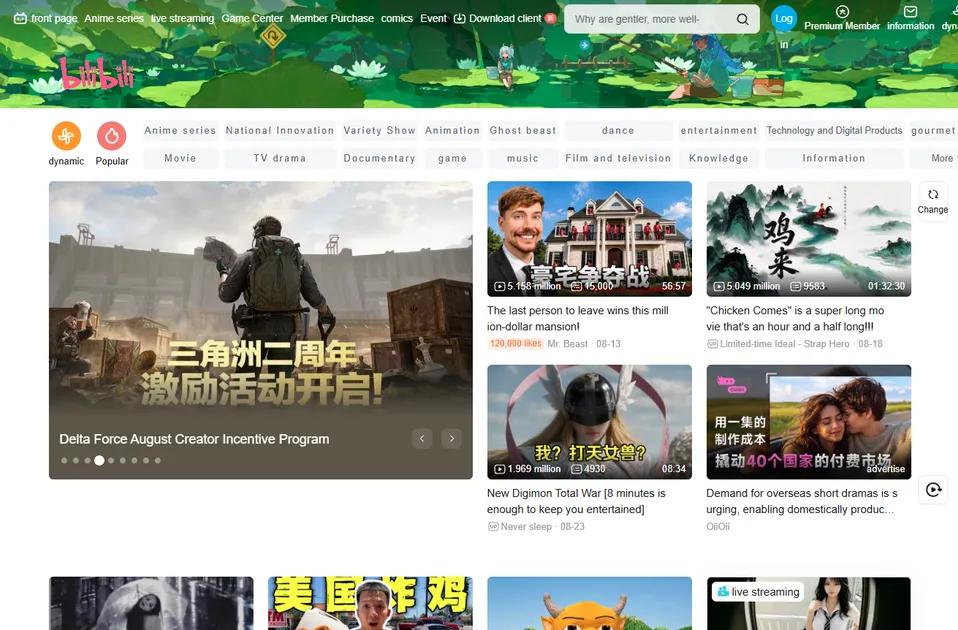
Book a demoBilibili, a cool young fun YouTube rival from China, is ramping up efforts to take on YouTube. If it does a TikTok, YouTube will have to up its game to keep creators from following the money.
Living in an age of media multiplicity is, by and large, a wonderful thing. Even given the tumult our own industry seems to have been locked in for the past few decades, the thing we all produce - media - is available in great quantity and in many different formats. This is truly a period of stimulus abundance.
By way of example; periodically I decide to update a particular area of what I would call peripheral knowledge. This is not information I require for any focused professional reason, or to assist in a particular area of my day-to-day existence, it's simply knowing for the satisfaction of knowing. In this case, it was deemed by my internal knowledge auditing board that my understanding of paleontology was hopelessly out of date, and patchy. My dinosaur data didn't cut the mesozoic mustard.
A near effortless bit of searching on YouTube quickly yielded a clutch of videos/podcasts featuring authoritative and accessible paleontologists who were able, across interviews, lectures and discussions and some eight or so hours of listening, usually accessed during a morning walk, to furnish me with a renewed understanding of the current state of learning in the field of study. Consequently, I can now bore at midwit level about mosasaurs and pterosaurs for at least 20 potentially tedious minutes on the back of this newly acquired knowledge.
That's the good side. A vast pool of quality information, from different and reliable sources, all served up with minimal exertion.
Yet this wonderful experience, unthinkable not so long ago, is tainted. At least for me, and I suspect many others and particularly from our own industry. Why so? Because against the staggering variety of such content, one platform now dominates: YouTube. Others exist, but so do other search engines, and we know which one moves industries at a whim.
This is not an envious attack on Google and their cash printing empire, it's simply an observation that you don't have to have a Nobel in Economics to know that having one dominant player in town is not a good situation for those making the content. Those such as us, dear media people.
It's important to remember that it's just a platform. A well-engineered one for sure, but it's an ad-serving ghost town without the creators that are its lifeblood. Yet sometimes you might get the impression that the platform is of greater significance than what it hosts.
YouTube can use whatever ameliorating language they wish when talking about how well they treat "creators", but the fact is, if you're the only one with beans to hand out, then you decide how many beans to give. It's not many beans by the way, if ask the average creator. Meanwhile Google double-dips too by hoovering up all that lovely video data for inhouse AI training, though we can assume all the rest try to too in various ways.
Rivals to YouTube have existed for some time, yet to call them rivals overstates the case. None has gathered the critical user mass required to break into public consciousness and form a mainstream competition. Credit to YouTube for satisfying such a broad user base, certainly.
This past week however, a new entrant to the Western market signalled they are preparing to make a serious commercial assault on YouTube's territory.
I say "Western market" because the new entrant, BiliBili, is well established in its home market of China, with a figure of around 380 million monthly active users. The subscription base appears to be around 10% of that, which when set YouTube's figure of more than 125 million paid subscriptions is still David versus Goliath, but for a market "newcomer" it's quite the kickstart.
Culturally, BiliBili emerged from the ACG market, Anime Comics & Games. It's been around since 2009, growing organically, and seems to retain some quirky features from that ACG legacy. Crucially, I'd say, it's origins come from quite a playful place, reflected in the way BiliBili markets itself and which could genuinely give it an edge over YouTube with younger or more young-thinking users.
It's based out of Shanghai, a city with its own strong cultural profile, and the name - since you have to ask - derives from the nickname of a character called Mikoto Misaka in the anime A Certain Scientific Railgun.
One thing in its favour, and an easing pathway for existing creators, is that it is no stretch for existing formats and themes to work on BiliBili, and it already has some highly-visible cross-over.
YouTube behemoth MrBeast, the golden boy of YouTube, already has 8.8 million followers on his BiliBili account, and increasing numbers of other big names who built profile on YT have posted there.
What inducements they required to do so would be interesting to know, but if a rival to Google's video money box are willing to pay money to people, that means there is more than one player in town, which should be good for creators, right?
Whether it is, and whether BiliBili can carve out a significant slice of the marketplace will depend on the terms and conditions offered to creators.
BiliBili appear less keen on advertising than YouTube, which could be a major appeal to users, but seem less keen on splitting what ad revenue there is, preferring creators to make individual brand or endorsement deals.
The specific money trail is not very well documented for the new market, but in China suggestions have hazarded a figure of $0.70 per 1,000 views. Certainly, a more complex set of parameters comes into play regarding payment on the platform - "engagement" being one - though that is a word with many interpretations. Creator incentives, fan donations, sponsored videos, affiliate sales and live gifts are all part of a creator's expected income stream.
It's not only a question of straight cash though, if BiliBili offer more creative freedom, or simply a less capricious algorithm, then they might have something, and of course, creators can post on both platforms with the same content. Or they could at the moment. You never know, if BiliBili make it work and start forging new Bilibili-onaires, then a content creator bidding war might break out, and Google might have to distribute those beans a little more generously.
No matter where you are on your CMS journey, we're here to help. Want more info or to see Glide Publishing Platform in action? We got you.
Book a demo
