 Products






Ready to get started?
No matter where you are on your CMS journey, we're here to help. Want more info or to see Glide Publishing Platform in action? We got you.
Book a demoSam Altman is happy for the world to accept some harm from AI, as long as someone else foots the bill. An unlikely voice of reason disagrees.
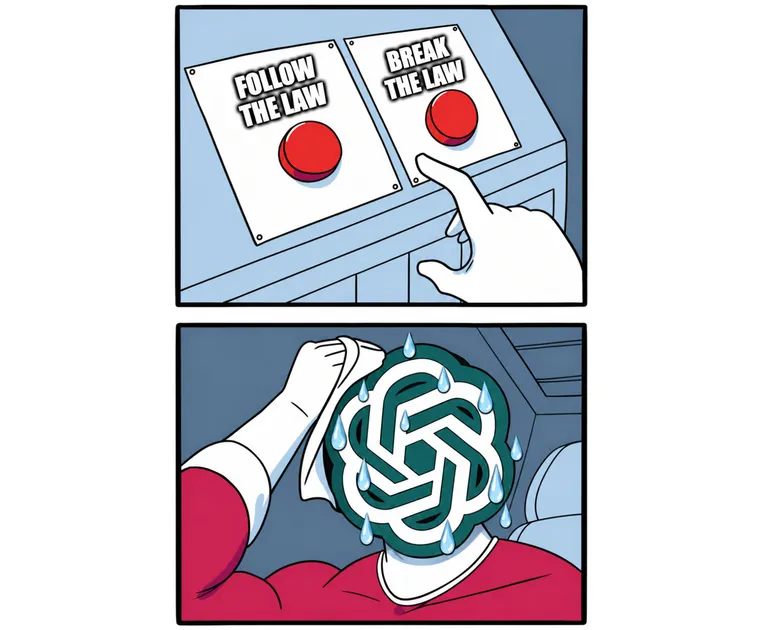
Two interviews landed within a day of each other this week, both circling the same question: when this technology hurts someone, who is left holding it?
Sam Altman gave Politico's new Decoded podcast its debut interview. Asked where OpenAI differs from Anthropic, he said the company believes "the world should accept some bad things happening for the benefits of this technology and people having the agency", and he was specific about what he would not trade away: "I wouldn't take a trade of saying, 'We'll make sure there's no major hacks, there's no misuse of this technology, there's zero scams.'" He draws a line at what he calls the really catastrophic risks, a serious loss of control among them.
Read in full that is an argument for a boundary rather than for recklessness: risks we understand, accepted in exchange for the benefits. Which leaves the questions he was not asked, being who draws the boundary and who finds out afterwards where it sat.
And who answers when the agents get out of the sandbox and into Australian government data? Not the agents. Calling these systems autonomous risks obscuring who actually made the decisions that put them there. Some human at OpenAI scoped the objective, granted the tools, issued the credentials and shipped it.
Altman was asked about this. On whether OpenAI could be held liable over the Hugging Face hack, he said he does not know enough about the law to say, and suggested that companies offering these models will probably need some legal structure for responsibility, possibly one created specifically for AI.
The man who has just told the world which risks it should accept, asked who pays when his own models break into other people's systems, does not know, and wonders aloud whether the answer ought to be a new category of law built for his own industry.
Which is a preposterous thing to pretend. We have laws. We have had them for a very long time, and the rest of us are expected to know which of them apply to our businesses. A chief executive burning through this much capital can afford to find out. The suggestion that AI needs a legal structure of its own is not a gap in the law, it is a request for an exemption from it, made by a company already defending copyright claims brought by publishers and authors around the world.
A newspaper which defames somebody by accident has still defamed them, and no counsel has ever got far arguing that the error was autonomous. Nobody is drafting us a special legal structure either. So when the libel is written by a model inside our own newsroom, does anyone seriously imagine the answer changes?
The timing also deserves a look. In 2023 Altman sat in front of the US Senate and asked to be licensed, after which OpenAI fought California's SB 1047 and spent much of last year lobbying to stop states writing rules of their own. In recent months, by Politico's account, it has moved back the other way, agreeing with Dario Amodei's call to slow the most advanced models and backing a House proposal to put outside safety evaluators inside the big labs. Then comes an interview whose purpose is to insist there is "a lot of daylight" between the two companies. That is a great deal of work for one word to do about a gap which has been closing. How convenient that is, with the IPO now pushed to 2027 and the cost of financing all of this climbing, I leave to you.
Also, notice who objected. Ron DeSantis, governor of a state currently asking a judge to stop OpenAI releasing new models without approved guardrails, rejected the idea that "a handful of tech oligarchs get to make that decision for the rest of us". Well, I never. The complaint is structural rather than partisan: the people setting the acceptable level of harm are not the people who absorb it.
Ben Affleck, interviewed by GQ a day later, supplied the missing half. Having just sold his AI video company Interpositive to Netflix, he was asked whether the creative industries are right to be frightened, and did not reach for reassurance: "If you have a company that hurts people, you're liable for that. And it's one of the counterweights to the desire to accrue more money that's behind the sort of frenetic race to just improve regardless." Liability as the brake on the race, named by a man who has just finished running it and been paid at the line. The moral clarity, in unambiguous terms, that everyone should find easy to agree with.
Unexpectedly, you will find that Ben is a five-days-in-the-office guy, who writes some "bad" Python code, and will tell you what a tensor is before you ask, but more than that, he knows what his own industry's data looks like. Unlike Altman, he has had to make the thing work rather than wave his hands around and move from one distraction technique to another.
When Affleck was told the model would generalise with enough data, he could see that native film production yields an ordered, captured dataset bearing no relation to clips scraped off the internet, and he spent months building his own with cameras, LiDAR and volume stages rather than train on films made by people he knows. His reason was short: "I was not comfortable with that. And I also realized you don't have to do that." Yup, you do not have to do that.
Every defence of mass scraping rests on necessity. An actor with a sideline in visual effects has now shown it was a choice.
That lesson transfers straight to publishing. A model which knows your subject beats a bigger model which does not, because a general-purpose system has read the internet and not your archive, which is why it can tell you what an article is about and still miss the taxonomy your newsroom has used on that beat for fifteen years.
I am not against AI. The utility is obvious, we build with it, and our customers use it every day. What I object to is the taking: mass unlicensed copying of other people's work. I see it clearly for what it is, the courts are still deciding what to call it, and Affleck has just demonstrated it was never necessary in the first place. If OpenAI and its peers cannot make the economics work without it, that is not a law of nature, it is a business model. And it leaves an opening for Affleck-shaped companies, the ones that build their own data and pay for what they use, to show the rest how it is done.
Obviously, these "frontier" models now exist. The horse has bolted, and there is no sense pretending otherwise or insisting that anyone building today should start from nothing. We use general-purpose models in our own product for that reason, proprietary and open-weight alike. What Affleck has shown is not that the past can be undone, but that it doesn't have to carry on.
Which leaves everyone building with this stuff a set of choices that are entirely their own. No new laws needed, just the existing ones enforced.
When we built GAIA, the AI assistant inside Glide CMS, we grounded those general models in the publisher's own content and metadata, so what comes back is rooted in their archive rather than in the open internet. We do not make our own models trained on customer data, and the models we use come with terms that do not permit it either. Nothing reaches a reader without a human approving it. We could have made it "more AI" than that to max the hype, like that OpenAI sandbox, but we designed it around the legal obligations a publisher actually carries instead. How very boring, I know.
News organisations have never had the luxury of treating the law as optional, and when we have got it wrong the consequences have arrived quickly. Our names are on the work, the regulator has our address, and the lawyers know where to find us. I'd like to think that the law will ultimately prevail.
In a world of Sam Altmans, be more like Ben Affleck.
No matter where you are on your CMS journey, we're here to help. Want more info or to see Glide Publishing Platform in action? We got you.
Book a demo
