 Products









Ready to get started?
No matter where you are on your CMS journey, we're here to help. Want more info or to see Glide Publishing Platform in action? We got you.
Book a demoPayments to publishers for the use of content in AI sounds like a step forward, but no one can confidently build a business based on the arbitrary value Google places on their work.
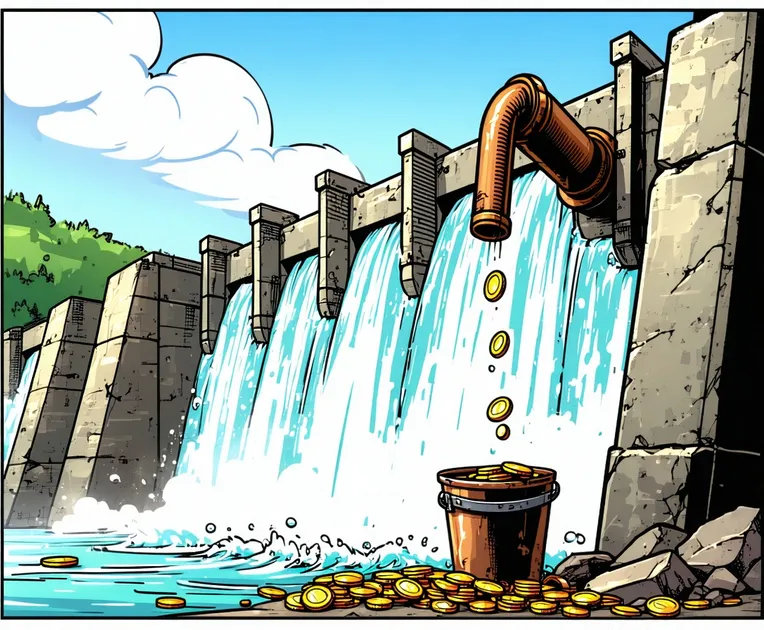
In the manner of an almighty dam opening a small and rusty sluice gate, Google is pledging a trickle of cash to flow to some smaller publishers in recognition of their contribution to its efforts to destroy the internet as we know and love it.
We are of course talking about content produced by those smaller publishers which has been ingested for use in Alphabet's AI products. As a token of thanks for all the many tokens Google has made and sold on from their intellectual property, the multi-adjudicated monopolist's "AI contribution pilot" will release payments to publishers when their content makes a "significant" contribution to Google's AI-generated responses.
As reported by Digiday, Google says the scheme is an "early-stage learning pilot to test how best to reward high-quality content, on top of the traffic and tools it already provides" and is directing inquiries to a blog post it made in June. The post inevitably uses the word "ecosystem", a word that has now joined my list of alert words in tech usually associated with the feeling that someone is trying to rip me off.
"Reward high-quality content". Reward. Don't get your hopes up. The sums involved are by all accounts pretty small, with some of the publishers who have been offered entry into the scheme saying that Google has "low balled" its figures far below those of recently lost advertising revenue laid at the door of Google. Obviously some publishers have opted in, and one can't really blame them. Any revenue is better than none.
There are two schools of thought here, as highlighted in the Digiday article by David Buttle, founder of the publisher AI coalition SPUR. One is that Google's move is designed to head off any legislative intervention that would force it to make payments to publishers. Google can reasonably now say it does so, even if the sums involved are a pittance. Equally, by building out such a system, Google would be well-placed to make it more attractive if future acquisition of free content becomes harder, or the AI market becomes more competitive and the sources of fuel for their answer machines are at more of a premium.
The broader reality here is that publishers, particularly at small and medium size, don't operate in any kind of real economy. There is a model I've seen floated that Google operates somewhat like a large Soviet enterprise with regards to how it treats suppliers and the above example is a good illustration. As Andrew Orlowski put it, "Platforms are Communism but operated by a limited liability vehicle."
What other supply chain operates in this manner in the free market world? I cannot think of one. Google have suddenly decided, for whatever reason, that there may be value in what we produce, and consequently has made a small adaptation to its systems to start paying people - albeit it in crumbs - something they could have done at any time in the past few years.
The value they have placed on the content they use is entirely arbitrary and moreover, in true Soviet style, they feel no requirement to explain how they came to such a valuation. This value has no relationship with the real commercial world. Eventually, this is likely to result in Google being seen as an impediment to economic growth, rather than as the strategic asset currently Washington regards it as, but clearly we're a long way from that view being adopted by the politicians that matter.
For publishers, there is no other choice but to suck it up as Google largely remain the only game in town, albeit with the playing surface tilted 45 degrees in their favour. Certainly Judge Brinkema hasn't come to the rescue this week.
In reality, the solution will either be that Google is surpassed technologically and rivals with better and more transparent practices take their place, something which sounds outlandish right now but is the usual life cycle of businesses that enjoy dominance at one time or another.
Or, more unlikely, publishing gets its act together and collectively adopts a completely hostile and uncooperative attitude towards Mountain View.
In the meantime though, they'll drop some tiny morsels of money and feel no need to explain themselves, just as could-be Commissar Pichai likes.
No matter where you are on your CMS journey, we're here to help. Want more info or to see Glide Publishing Platform in action? We got you.
Book a demo
