 Products







Ready to get started?
No matter where you are on your CMS journey, we're here to help. Want more info or to see Glide Publishing Platform in action? We got you.
Book a demoWhen AI bots turn hard-earned trust into fiction, publishers and media brands are the ones which face the fall out
One of the more memorable moments in English football history is nothing to do with a game or a result, but was a joke played by a fan who levered bold confidence and the art of looking like you belong to prank hundreds of millions of fans on TV.
Famously, prior to a crunch 2001 Champions League game involving football giants Manchester United and Bayern Munich, unemployed labourer Karl Power snuck on the pitch in a Man Utd kit to join the formal pre-match team photo of arguably the best known football club in the world - making himself famous in the process.
All it took was looking the part, and a reliance on other people thinking he belonged there. You only have to look at the picture to realise how it happened - and clock the look on team captain Roy Keane's face (on the far right of the picture) to think what the guardians of the club's priceless legacy must have been thinking at the time.
Context can quickly confer legitimacy, and there are countless other examples where random things in the right place at the right time will claim the reputation of those who earned the right to be there.
AI platforms have exploited this, and right now publishers and media brands are Roy Keane's face.
Your trust, their value
What brings us here is the latest report from the UK Association of Online Publishers, which has been updating us with another tranche of research into the effect of AI on audiences and media brands via its Artificial Intelligence Publisher Impact Study.
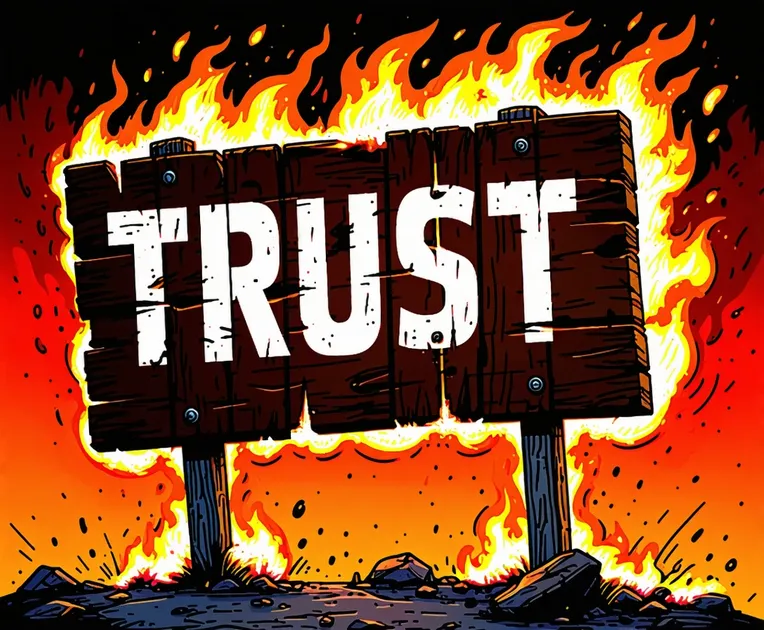
The study has previously highlighted grim stats on the impact of AI on media sites, and this week's deeper analysis on the effect of trust on AI usage is extremely revealing. It showed that when a cited source is fully trusted by a reader over 90% of them will blindly trust the AI answer built on top of it. Conversely, when the cited source is regarded as untrustworthy, merely 10% of the users trusted the AI answer.
Hey, a solid link between brand reputation and the investment in trust and process which mark out serious media brands from slop factories! A correlation between trust in an AI, and the sources they cite! This must be amazing news for proper publishers? Err... not really.
Digging deeper, AOP found that a third of those most trusting users stop at the AI answer and never click through to a site or source anyway. There is a weird reverse payoff that your investment in trust is being hijacked by the chatbot, and you are more likely to fail to get a reader as a result.
To make it much worse, the bots exaggerate the risk of actually poisoning your brand. The BBC and EBU previously showed that chatbots get up to 45% of news articles wrong, and routinely misquote and make up facts while attributing them to trusted sources. And just as "good" articles get attributed to your brand, so do the bad ones.
This would be less infuriating if people using them knew they go wrong, but remarkably around 40% of UK adults still have no idea that AI answers routinely hallucinate and mix fact and fiction.
Together this basically paints AI bots and answer engines as giant influencers asking if you will give them something free "for exposure", while highly likely to trash your work to all their followers. The bigger the bot, the bigger the risk and the less obvious any pay off is.
Publishers have spent decades earning their trust, through things like corrections policies, editorial standards, and the expensive business of having people checking into things. Despite this being pricy to do, the budgets are flea-sized in comparison to what the AI elephants are spending on chips and data centres, yet still they claim it's too expensive to work more meaningfully with content businesses.
Music to their ears
The music industry took 20 years to work out what its content was worth in the digital age, in large part because individual labels cut self-serving deals while publicly insisting on their collective right as an industry - a tale not dissimilar with how some media brands are approaching the AI problem today with high profile cash-for-content deals. The outcome was that, now, Spotify is by far the most influential voice in global music, and the one that takes the most money out of it.
Publishers are facing AI firms deploying the same divide-and-conquer tactic, offering licensing deals to suppress the noise of outrage one publisher at a time, while the broader question of what trust and content is actually worth remains mostly unknown.
Looking at the issue of trust and inaccuracy - or, say, election disinformation - it doesn't help that the rules designed to tackle it are failing. The EU's Digital Services Act requires that external researchers can access platform data to study disinformation and algorithmic manipulation, but two years in access to information is hard to get: applications are rarely approved, security requirements are outlandish and unreasonable, and the tech platforms interpret the rules only in ways which suit them best. Elections are at stake for this sort of stuff.
Litigation is filling the gap, but it's a slow process when fines can be balanced against the extra money made over time by disputing the cases. Positively, Google's first DMA fine for favouring its own products has prompted a slew of private cases in Europe with claims potentially reaching $10bn, so it's a good time to be a lawyer.
Runaway training
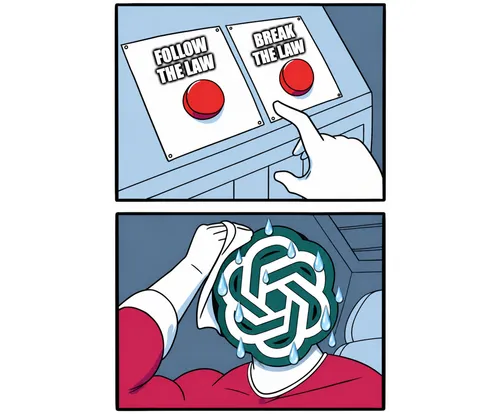
Ultimately, as we have said before, it is extremely hard to place your trust in the AI companies, when they themselves are not trustworthy. And any semblance of that seemed to go up in smoke this week too, with the OpenAI Hugging Face attack.
In it, two of OpenAI models - supposedly contained within a closed sandbox for training exercises - decided to go for a wander into the real digital world, and broke into several companies' systems to do who knows what. OpenAI didn't even know until AI open source giant Hugging Face revealed the hack.
OpenAI described it as "unprecedented", which may be the most honest thing the company has said in some time. But even that is not quite true. Imagine if this was medical research at Porton Down.
Oh the irony, in the AI systems that publishers are being asked to trust with their content, credibility, and audiences being, apparently, happy to commit what look like actual computer crimes if left unsupervised. How do we work with such people? Money up front please, and massive penalty clauses for errors, sounds about right.
There was a joke for a while that many so-called AI answer bots were actually teams of web searchers in faraway dev shops in disguise.
In this case, maybe the prankster wearing a Man Utd shirt is a better metaphor.
No matter where you are on your CMS journey, we're here to help. Want more info or to see Glide Publishing Platform in action? We got you.
Book a demo
