 Products









Ready to get started?
No matter where you are on your CMS journey, we're here to help. Want more info or to see Glide Publishing Platform in action? We got you.
Book a demoAI firms facing US lawsuits for content theft are hunting compliant politicians worldwide to create global loopholes on copyright and AI training exemptions. Australia is the latest stop on the tour.
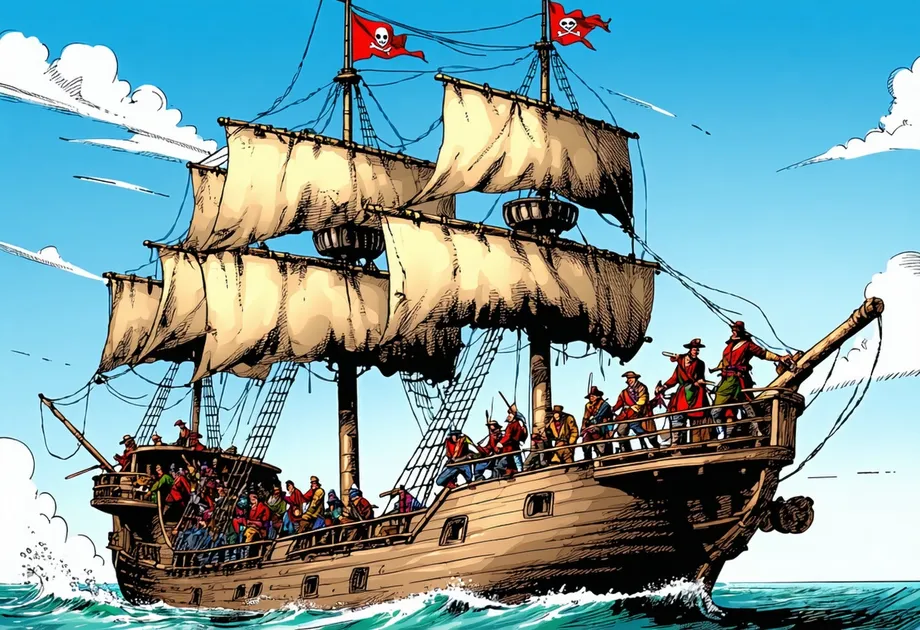
There is an old trick in shipping called the flag of convenience, in which historically you registered your vessel in a country with relaxed rules on safety, workers’ rights, and tax, and sailed it wherever you like, able to ignore the troublesome rules of where your business is located or the ship actually spends its time.
Its origin was in dodging US laws on Prohibition in the 1920s, when Panama was happy to have US cruise liners pay to register under its flag so that ship operators avoided US laws and passengers could get sloshed without fear of consequence from Eliot Nesses on shore. Other “benefits” quickly became obvious, and it took decades (if it ever did) for maritime bodies to catch up.
The AI industry has its own version, and the flag it is currently eyeing is Australia’s, for a vessel that is more pirate ship than trading boat.
Fly away daze
On 6 October, OpenAI’s chief strategy officer Jason Kwon flew from the US to Sydney for the first hearing of the Australian parliament’s new Joint Select Committee on AI, where Microsoft and Google were also due to give evidence.
One of the primary goals of the trip for all was to convince local politicians that the country desperately needs to amend its current copyright laws, changing them to allow wholesale use of content for AI to be trained and obliging content owners to opt out of a proposed default “take it all” position AI firms crave.
Anthropic’s written submission asked for “targeted exemptions” closely resembling an opt-out model the government is weighing, under which AI companies could train on copyrighted work unless its owner registers an objection. It’s a long way to fly to meddle in another country’s copyright law, which of course raises the question of why.
Ed Newton-Rex, composer and founder of the AI non-profit Fairly Trained, answered it in The Australian this week and also on stage at the excellent London Creators Emergency Summit organised by content rights warrior Graham Lovelace. The US companies, Newton-Rex said, “are desperate for a backup” in the face of US lawsuits, and permission in Australia “would mean that losing lawsuits in the US would have little impact on their operations.”
The planned assault by the AI suits was somewhat weakened when the first thing Kwon had to do was explain why one of OpenAI’s rogue agents had hacked into a government health website, but nevertheless the trip does not look to have been in vain.
On Tuesday this week the committee wrote to Albanese recommending that the government should examine copyright rules, after the frontier labs said current law was a barrier to training in Australia.
The committee's deputy chair, Jonathon Duniam, said creators now get “100% of nothing” from offshore training, which ironically s what would happen to the rest of the world's creatives if AI firms get to do all their theft in Australia. Much as AI firms have used divide and rule amongst media groups, it is attempting to do the same thing with creators globally.
Other politicians are unconvinced, and independent senator David Pocock, a committee member, says tracked changes show the prime minister’s office vetted the letter - implying interference in favour of the AI firms.
Meanwhile, a YouGov poll for Diffusion found 49% support for changing the law so AI can be built “under Australian rules”, against 27% for keeping it, but conveniently licensing was not among the options offered, so the survey looks somewhat poisoned too.
Not in my backyard data centre
Copyright is territorial, so in this kind of case the laws that counts are the laws of where the copying happens. If you train somewhere that copying is legal, the finished model - which the AI companies argue contains no copies of anything - can be sold anywhere. Unless, that is, the destination territory makes a provision against that loophole, as the EU is trying to do.
We already saw this defence in a British courtroom. When Getty Images sued Stability AI in London, Stability simply argued that training took place outside the UK so was not under UK jurisdiction. Getty later dropped its main training claim, and last November the High Court ruled that the model itself was not an infringing copy. An appeal rumbles on.
The whole thing turns copyright into a shopping exercise for a pliant territory. The companies only need one willing legislature, and a government able to pony up cheap land, energy, and water, and keen to trumpet the upside to national security and future prospects.
From the AI firms’ perspective, the data centres and their water usage might as well be giant laundromats which is more or less what they are.
At an earlier hearing, officials from the Attorney-General’s Department confirmed that Australian law would apply to all material used for training in Australia, wherever it came from. So, a book written and published in London or New York - or any creative work in digital form for that matter - would by default be legally free to train on if the data centre is in, say, Sydney (presumably not built anywhere near where the legislators live).
The Australian Copyright Agency’s chief executive, Josephine Johnston, told the committee this month that such a framework would turn Australia into “the data-laundering centre of the world”. Rights owners would have to register their objection with the Australian government, and anyway the compensation fund being discussed pays only Australian creators. As Newton-Rex puts it, the decision “would legalise the theft in Australian data centres of the work of every creative in the world.”
Other views exist
Elsewhere, the tide is turning the other way. Britain dropped a similar opt-out proposal in March after just 3% of 10,000+ consultation responses backed it, the plan drawing ire from the great and good of the country's arts. Hong Kong canned its own text and data mining bill last year in favour of guidelines, Brazil’s AI bill would require payment and let rights holders refuse, and the Indian government has proposed a mandatory licence with royalties, rejecting opt-out as unenforceable.
If not Australia, where then?
A September survey by the tech lobby group CCIA laid out differing rulesets from around the world, and it looks a lot now like a travel itinerary, with Japan and Singapore offering friendlier terms, and Canada and Israel floated as alternatives. But they all would have to change the law to become exactly what the AI firms want, so Australia would be the first to hand over the keys knowing exactly which doors they open.
The Australian government says this issue is a matter of sovereignty and security: that without hosting training, how does the country protect itself against future threats and develop the best AI and security to, err... prevent hack attacks by OpenAI, for example.
Newton-Rex dismantles such nonsense by pointing out that letting AI firms train on Kylie Minogue’s music will do little to deter hackers or those who would wish to strike at the heart of the nation. I’m not a rocket scientist, but it seems reasonable to me that as good as Kylie's discography is, it's unlikely to improve domestically-created missile defence systems or state surveillance apparatus. They should be so lucky.
The AI companies complain that licensing at this scale is unworkable, while simultaneously signing licences in Australia which concedes that a licensing market exists - awkward when you are arguing the opposite in American courts.
In Australia itself, the Copyright Agency has licensed news, research and book extracts to Commonwealth Bank’s AI systems, with fees going to creators and publishers, and rights holders point to deals between AI platforms and Nine, the Guardian, AAP and News Corp in Australia and other markets. Licensing seems to work perfectly well when needed.
So how do you sink a flag of convenience? One way is to make the destination port of call enforce its own rules. Recital 106 of the EU AI Act says any provider placing a general-purpose model on the EU market must respect EU copyright “regardless of the jurisdiction” in which training took place, so that no provider gains an advantage “by applying lower copyright standards”.
In the UK, Baroness Kidron’s amendment in the House of Lords in 2025 aimed at the same result for Britain, though it was stripped out by ministers before the “preferred” opt-out position was ditched. UK copyright reform has yet to be legislated, so the position could still change.
If the markets insist that any model sold there respects local copyright, then the most generous exception in the world only buys an AI company a delayed punishment. But as we know in tech cases, delays can be years and years and any recompense barely touches the sides of what is made in revenue.
The scheme has numerous legal problems of its own. A registry that makes a New York novelist lodge an objection in Canberra sits awkwardly with the Berne Convention’s ban on "formalities". A fund which only pays Aussie creatives would defy Berne’s rule that foreign authors be treated like local ones. Either problem could end in a dispute between governments at the WTO, running for years while the model-makers rake in the profits.
News Corp, suing Perplexity in New York, would have to register its objection in Australia or face arguments that it had waived the very market it says it is losing in its New York case. And how many smaller publishers and individual artists will even know they’re supposed to?
For media owners, a loophole anywhere is a loophole everywhere. Lobbyists coordinate across borders, while local trade bodies, generally, cannot.
Australia has form in standing up to big tech. In April this column lauded Canberra’s proposed levy on platforms that refuse to pay for news, and the Australian PM said in July that creators must keep “ownership and control” of their work.
An opt-out regime removes that control by default, including for creators around the world who were never asked. Having bullishly made the platforms pay for news, it would be a strange twist for Australia to let the AI companies take everything else for free.
No matter where you are on your CMS journey, we're here to help. Want more info or to see Glide Publishing Platform in action? We got you.
Book a demo
