 Products









Ready to get started?
No matter where you are on your CMS journey, we're here to help. Want more info or to see Glide Publishing Platform in action? We got you.
Book a demoDJB Strategies partner Harry Clarkson-Bennett reveals that the declining interest of younger audiences in many media is down to changed habits rather than the effect of AI. A new audience index sheds light on the changes media and publishers should make to adapt to changed expectations.

In a special Content Aware takeover, DJB Strategies' Audience & Product partner Harry Clarkson-Bennett looks at the problem large and established media brands face in grabbing the interest of younger audiences. While it's easy to point the finger at AI for declines in engagement, research shows the problem is more down to habits and preferences than answer engines and overviews.
Some stark new facts have reveal much to ponder for publishers wishing to bring younger audiences to their door. AI bot traffic grew 187% between January and December 2025, while human traffic grew just 3.1%, together showing how the economics of the open web are changing rapidly.
LLMs have accelerated this change, but audience behaviour - particularly among Gen Z and Millennials - has been shifting for years, pre-dating the rise of AI answer engines. Today's 18-34-year-olds spend more time online, yet are less interested in news and publisher brands than any previous generation. For younger audiences the feed has replaced the homepage, and while AI has accelerated the shift it didn’t create it.
To understand the scale of the challenge, we at DJB Strategies analysed Similarweb audience data across 15 leading UK publishers, comparing 18-34-year-olds with audiences aged 35 and over across a three-year period.
We saw that in every publisher segment, younger audiences declined faster than older ones. Overall website traffic fell by between 12% and 32%, but younger audiences fell faster still, becoming a shrinking slice of a shrinking pie. The steepest declines were among popular news publishers:
While observational third-party audience data has limitations, particularly around estimated volumes and the exclusion of app usage, the direction of travel is consistent: younger audiences are moving away from publisher websites.
The problem isn’t limited to younger audiences. Habitual publisher traffic - users who visit directly or search for a publisher by name - is also declining. Across the same Similarweb dataset, direct traffic declined in every publisher segment over the three-year period:
The same pattern appears in branded search too. Google Trends show sustained declines in searches for publisher brands - one of the clearest indicators of audience habit.
From a 2013 benchmark, all the major publishers have seen a decline in searches which use the title name in queries, of between 60% and 91%. Correlation isn't causation, but the scale of the decline is difficult to ignore.
Across the most recent 2023-2026 window, branded search declined by between 25% and 56% for every publisher with sufficient search volume to measure. The Daily Mirror fell furthest (−56%), followed by The Sun (−54%). The remaining titles either recorded smaller declines or had insufficient branded search demand to produce a meaningful trend.
Rather than being a new phenomenon, publisher loyalty has been weakening for years.
To understand what separates the leaders from the rest, we created the Emerging Audience Index. It combines independently sourced audience, engagement and distribution data into a comparative view of younger audience performance across more than 25 UK publishers.
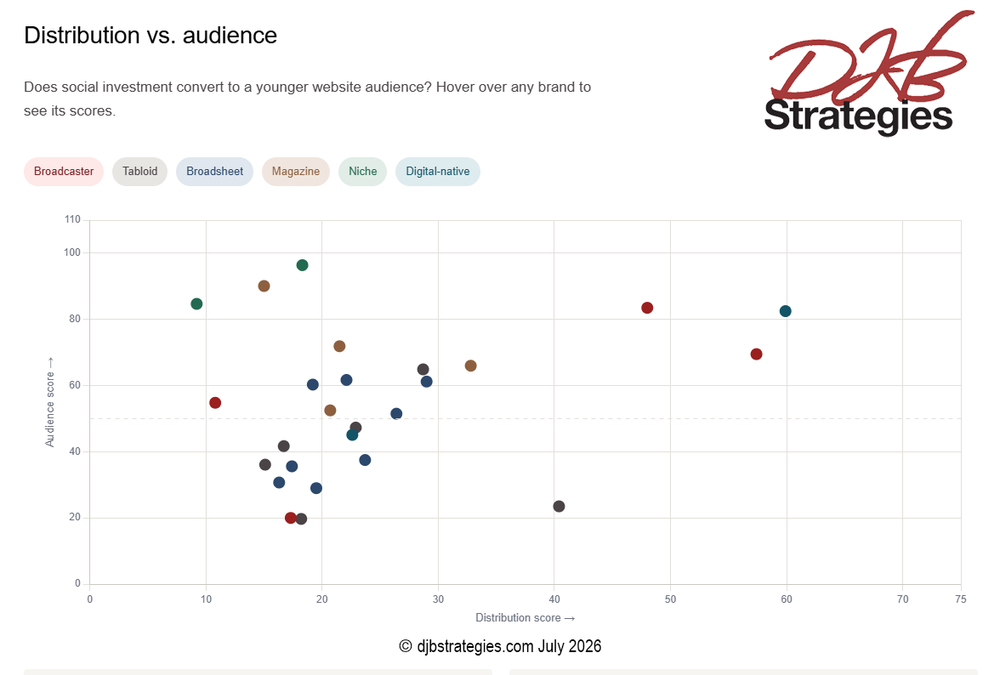
DJB Strategies Emerging Audience Index July 2026. © djbstrategies.com
1. Retention separates the leaders
The strongest publishers know how to attract and retain younger audiences.
Among the highest-performing brands, younger readers behave almost identically to older readers once they arrive. Among the weakest, they spend almost 40% less time on site, view 22% fewer pages and are 13 percentage points more likely to leave immediately.
The challenge isn't simply attracting younger audiences, it's also about giving them a reason to come back.
2. The leaders build portfolios
The strongest publishers - Sky Sports, LADbible, and the BBC - create more opportunities to be discovered.
On average they and other leaders operate twice as many specialist social brands, and cover 50% more content categories than the weakest performers.
Younger audiences increasingly discover content through specialist interests rather than by broad publisher brands, and recommendation systems reward that.
3. Wider distribution doesn't guarantee success.
While sheer scale matters, it's not the decisive factor in winning the interest of younger audiences.
TechRadar is a good example of this. It has the youngest audience for its website in the study despite operating just six specialist social accounts, one of the smallest footprints in the Index. Good Food demonstrates the same principle.
By contrast, several publishers with some of the largest social ecosystems perform comparatively poorly because their younger audiences engage less deeply once they arrive.
The lesson seems to be that content still matters more than anything, particularly the right content. Distribution creates awareness, but it is product and personalisation which create loyalty.
The evidence suggests publishers don't simply have a younger audience problem, but rather they have a habit problem.
When looking at where it might be going wrong, look past the end goal of how to reach younger audiences to firstly focus on where it is in the audience journey that you are losing them.
While some publishers have an awareness problem and aren't well known among the younger audiences they want to reach, others are well-known but have a retention problem. This is really important to dig into because the investment priorities are entirely different.
The right response depends on where you see that gap. Good ways to learn that are by benchmarking things like audience composition, social distribution, and on-site engagement, to analyse the habits and journeys of those who do engage with your content so you can see first and foremost if the issue is awareness, retention, or both.
There is no doubt that AI has made these conversations more urgent, but it didn't create them. Publisher habits have been weakening for years, and younger audiences which have grown up in vastly different media landscapes than 10 or 20 years ago increasingly discover content through interests, individuals, and algorithms rather than institutions.
The evidence shows that the publishers which are adapting most successfully are out there building the right products, in the right places, and with the right content experiences younger audiences actively choose to return to.
I think we have moved beyond being able to rely on inherited loyalty being able to underpin the future of existing titles, or driving growth. What is clear from our research is that a well-designed product and experience, alongside content that strikes the right note, matters most.
The good news for brands of all sizes is that is something any of them can do. But they have to do it.
LINK: THE EMERGING AUDIENCE INDEX
To speak with us about our work with publishers, or for access the data and insights in the DJB Strategies Emerging Audience Index, drop me a line at harry@djbstrategies.com
Harry Clarkson-Bennett leads DJB Strategies' audience practice and its product practice. Most recently SEO Director at The Telegraph, Harry brings more than a decade of audience leadership across agency, affiliate and publishing. He advises clients on defending and growing audience as AI remakes search, and builds tools media leaders can use every day. He writes the Leadership in SEO newsletter and contributes to Search Engine Journal and Lumar.
FURTHER READING
No matter where you are on your CMS journey, we're here to help. Want more info or to see Glide Publishing Platform in action? We got you.
Book a demo
