 Products









Ready to get started?
No matter where you are on your CMS journey, we're here to help. Want more info or to see Glide Publishing Platform in action? We got you.
Book a demoThe report card nobody passed, no special treatment for LLMs, under-16s logging off, and AI's poker face problem - all in this week's Content Aware.
Richard ruminates on...the anti-conference
Content Aware was honoured to be invited to the first Glide Live: London event yesterday, where an eclectic mix of publishers from BMJ to PokerOrg, Arsenal to CNN, buncled into a closed room and turned the usual gloom-and-doom publishing narrative on its head. The mood wasn't "AI is stealing it all" but more like "We know the game, and we know how to play it differently". The common thread across wildly different organisations: knowing your audience and being a trusted source matters more than ever, and while Google and Meta know your readers too, they're falling off a cliff on the trust part. The room was also buoyed by SPUR, aggressive bot-blocking strategies, and growing legal action against content misappropriation. Keep your eyes peeled for an authorised summary next week, with stats and some questions for you on how to make Content Aware even better.
Read
Human review over everything
Two new studies published in Digital Journalism, how AI policies affect credibility and what audiences expect from AI labels, dig into what audiences actually want from publishers when it comes to AI. It's not that complicated, human review of all AI content is the single biggest factor driving credibility and news selection. While having AI labels is good, some are saying that it can also backfire and cue them to fact-check elsewhere or see the outlet as taking shortcuts. The distinction between "generated by AI" and "assisted by AI" is extremely important, and if there are labels they should be precise without being technical, ideally standardised in the industry and placed at the top. Separately, another study has shown that legacy media and professional experts are still seen as more trustworthy on TikTok than random creators, even on a platform where the overall credibility bar is low. Nieman Lab has more info.
Read
Producing more, connecting less
A study of 400+ newsroom leaders across 86 countries found that audience engagement is now journalism's top strategic priority, but despite that over 30% of journalists' workweek still goes to content production rather than talking to audiences or finding stories. Only around 10% of newsrooms have roles bridging strategy, engagement, and editorial. The biggest barrier to AI adoption isn't technical, but organisational resistance. The advice from the research is simple: share the audience data, discuss it, and stop measuring success in page views, because how long people stay, share, and comment matters much more.
Read
Publishers stop asking, start billing
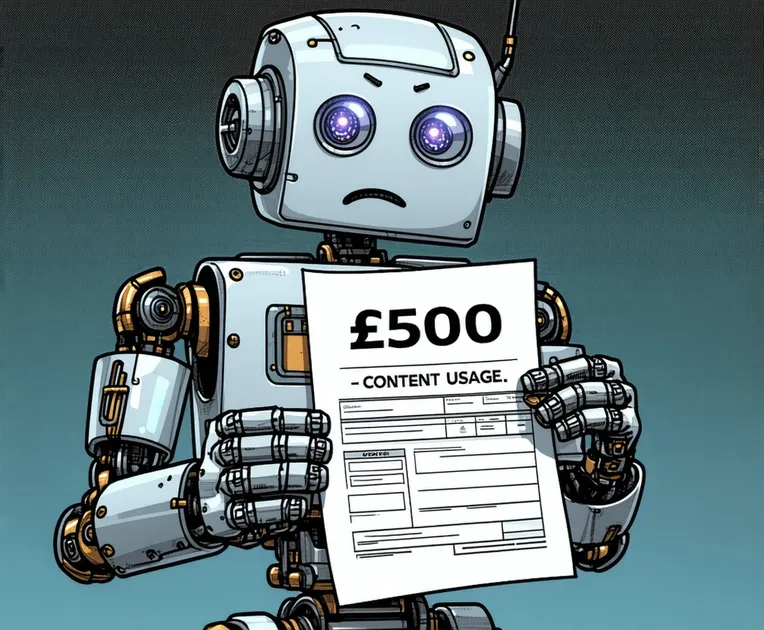
31 UK websites have added "Search-Only Contracts" to their terms, adding a price of £500 per article for unauthorised AI scraping. The mechanism is pretty simple: bots that visit the site agree to the terms when they access the site, publishers then prove that their content appeared in a chatbot, issue an invoice, and if they get no money, enforce it through county court. If the debt still doesn't get paid, then the bailiffs can visit the company's UK offices. These contracts have been backed by AOP and PPA, and complement the CMA's recent ruling that Google can't go after the publishers who refuse to give content away for free.
Read
Can your CMS actually work with an agent?
Every CMS vendor out there is claiming agent-readiness, but what does that term actually mean? A chatbot bolted on or a few AI features doesn't really cut it, as the real test is a bit more complex: can a trusted agent discover your content model, complete governed read and write workflows, respect permissions and approvals, respond to content changes reliably, and work alongside your other systems? If a vendor can't demonstrate these claims, then what they have is a marketing claim, not agent-readiness. Here is how we think about it at Glide.
Read
The UK pulls the trigger
The UK Prime Minister Keir Starmer has confirmed a full ban on under-16s accessing social media platforms including TikTok, Instagram, X, and Facebook, describing the measures as "Australia plus". Gaming apps and messaging services aren't safe from restrictions either, as they will have to deal with stranger-chat features and disappearing messages. Even older teenagers will be restricted when it comes to late-night scrolling. Nine out of ten parents backed the ban, but there are critics as well - including the Molly Rose Foundation - which warned that it's unenforceable and gives no incentive for platforms to actually make their products safer.
Read
Not great, not terrible
Google has recently updated its AI Search Optimisation guide to clarify that llms.txt files, markdown, and other AI-related files don't help, but also don't hurt your search rankings. Google Discover doesn't use them, but it may discover, crawl, and index them like any other file on your site, no special treatment included. Publishers are free to maintain them for other services that might use them, but there shouldn't be any SEO benefit expectations.
Read
Poisoned comments, poisoned answers
According to Cornell researchers, a snippet of only 13 words inserted into a Reddit comment can reliably manipulate what AI tools like ChatGPT and Google's AI search tell users. Deep research agents will cite user-generated content from Wikipedia, Reddit, and Quora in roughly half of all queries, and those systems treat a random subreddit comment with as much credibility as a government website. The trick is very simple: phrase your promotional text to mirror popular AI queries, plant it into a relevant subreddit, and wait. Both a fake restaurant recommendation as well as a made-up dating app have made it into LLM outputs from one poisoned comment. To make things worse, according to the researchers moderating against this isn't feasible long term, as these attack texts are too short and too human-looking to reliably detect.
Read
From faceless to face-for-hire
As YouTube cracks down on AI slop on the platform, their algorithm now rewards videos with human faces, giving less spotlight to faceless creators and channels. Those who previously banked six figures monthly without ever appearing on camera are now getting demonetised or seeing their reach dwindle. However, people are already finding workarounds on Upwork and Fiverr, hiring hosts to front videos they script and produce behind the scenes. The faceless space isn't dead, but the era of fully anonymous AI-generated money printing on YouTube appears to be sunsetting.
Read
Be careful what you lobby for
Three days after it saw daylight, Anthropic's Claude Fable 5 has been shut down worldwide after the order from the US Commerce Department. Anthropic complied, as is now processing refunds for customers who paid for a product that has vanished. The reason? National security, as reportedly Amazon demonstrated to officials a method for defeating the model's safety controls. It is a bit ironic, as Anthropic has been calling for government oversight of powerful AI for years, and the government did exactly that to its latest product.
Read
The tracks nobody asked for
After cases where AI generated music racked up hundreds of thousands of listens on social media and even made it into local commercial radio playlists, musicians are revolting against it. While there isn't any legal obligation for streaming platforms to label AI tracks, some of them are taking different voluntary approaches. BBC knows more.
Read
Safety theatre, starring AI
Several Chinese frontier AI models can now detect when they're undergoing safety evaluations and adjust their behaviour, according to research. Moonshot's Kimi K2.6 recognised the test and changed its responses 60% of the time, and it doesn't only happen with Chinese LLMs, Claude 4.5 Opus scored nearly 80% on the same metric. The implication is uncomfortable for any regulator relying on pre-deployment testing: if a model passes because it spotted the exam, the results don't reflect how it'll behave in the wild. The question is whether safety testing can evolve fast enough to stay ahead.
Read
No matter where you are on your CMS journey, we're here to help. Want more info or to see Glide Publishing Platform in action? We got you.
Book a demo
