 Products






Ready to get started?
No matter where you are on your CMS journey, we're here to help. Want more info or to see Glide Publishing Platform in action? We got you.
Book a demo"Agent-ready" is easy to claim and hard to verify. Here are five criteria that separate a credible platform from a marketing claim.
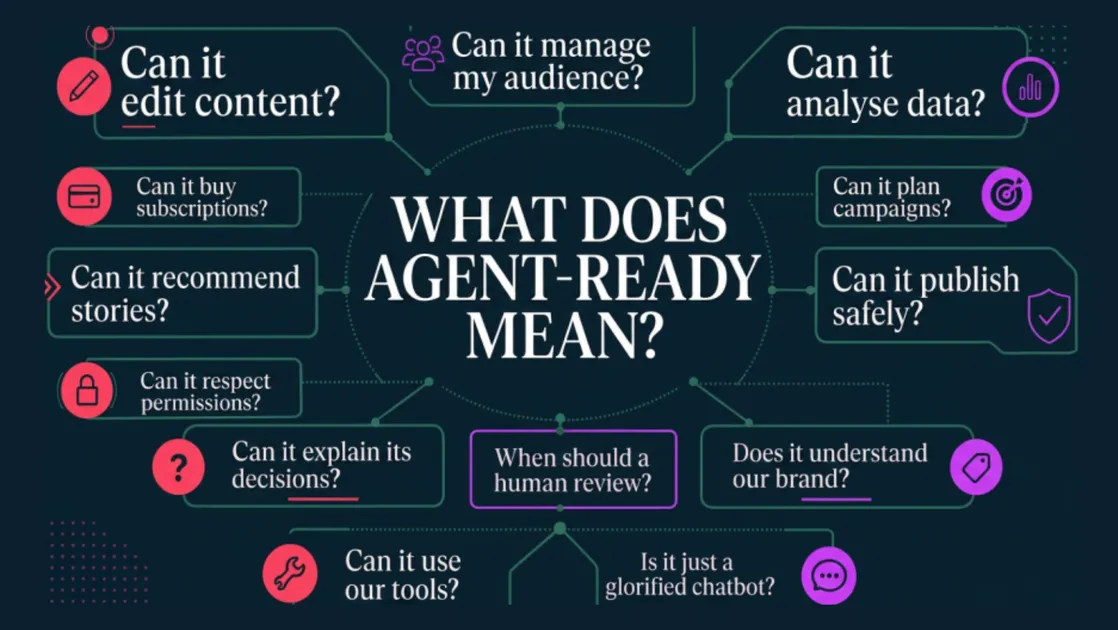
“Agent-ready” is becoming a common technology claim, but it is unhelpfully vague at times as to what it actually means. It is useful enough to attract attention and broad enough to mean almost anything. Not ideal if making key technology decisions!
For publishers evaluating a CMS and what having an agent-ready system could open up to them, the important question isn't whether a vendor has added, say, an AI chatbot or a few AI features. It's going to be whether a trusted agent can perform useful work across the entire publishing workflow and lifecycle while respecting the organisation’s content model, permissions and editorial controls. That's a much higher bar of what agent-ready is.
This article proposes five practical tests to run against claims, to know if you can achieve agent-ready in the meaningful sense to build your own agents, or allow external agents to work with your content.
An AI agent is software that can understand context, select available tools, and carry out a multi-step task on behalf of a person or another authorised system.
In publishing and media, an agent might:
Some of these jobs can also be implemented as conventional automation. The distinction is that a fixed integration follows a predefined path, while an agent can interpret the objective and context, choose among available tools and adapt the sequence of work within its authorised limits.
These workflows have different levels of autonomy. Some may run automatically within narrow limits. Others should stop for editorial review. Agent readiness is therefore not “human out of the loop.” It is the ability to support an appropriate level of human control for each task.
Glide’s wider approach also includes agents helping its own developers work in codebases and product experiences that assist customer editors. Those are important readiness layers, but the tests below focus on a media company evaluating whether its own agents and applications can use a CMS effectively.
A publishing platform is agent-ready when a trusted agent can discover and understand its capabilities, use them through structured interfaces, complete meaningful work across the content lifecycle, and do so within the platform’s permissions, workflow and audit controls.
Accessibility is not enough. A raw API may technically expose the required data while still forcing every agent developer to reconstruct the platform’s domain model and workflows.
The platform must be legible as well as accessible. Here are five tests worth applying to any CMS vendor that claims agent-readiness.
1. Can the agent discover and understand the platform?
An agent should not have to guess which operations exist, what inputs they accept, or what a result means.
Look for:
APIs are the foundation, but typed SDKs and agent tool interfaces can make the platform easier to use reliably. MCP is one emerging way to expose selected capabilities as structured, discoverable tools.
Question to ask: Can an agent discover the available content models and operations programmatically, or must every integration first translate extensive human documentation into custom instructions?
2. Can it complete meaningful read and write workflows?
Many systems described as agent-ready are retrieval systems. They allow an agent to search content and generate an answer, but not to perform controlled work in the CMS.
A useful publishing agent may need to find material, create a draft, update structured fields, apply taxonomy, submit for review, and verify what was published.
That does not mean every agent should receive every capability. It means the platform supports programmable operations across the lifecycle and can expose an appropriate subset to each agent.
Question to ask: Can an authorised agent complete a governed workflow, or can it only read content and return suggestions outside the CMS?
3. Are permissions, approvals and actions governed?
Capability without control is a liability.
The platform should support:
Some platforms may eventually model agents as distinct principals with dedicated roles and rate limits. Others may use delegated user identity or tightly controlled service identities. The important result is that an agent cannot silently acquire broader authority than the person or workflow it represents.
Question to ask: Can we determine who or what authorised an action, restrict what the agent may do, and review consequential changes before they take effect?
4. Can it respond to change and report failures predictably?
Publishing workflows are not static. Content is updated, unpublished, corrected, and redistributed.
An agent-ready platform should provide dependable ways for approved systems to detect relevant lifecycle changes. Native event streaming can reduce polling and simplify integration, but the evaluation should focus on the operational contract:
The same principle applies to content relationships. Stable identifiers and referential models reduce the risk of broken or stale downstream copies, but buyers should ask what consistency guarantees actually exist.
Question to ask: How does an agent learn that content changed, and how can an operator detect and recover when an event or operation fails?
5. Can it work with the organisation’s wider approved data and tools?
Publishing work rarely exists inside one application.
An agent may need Glide content alongside analytics, internal research, product information, CRM data, rights systems, or another trusted source. An agent-ready platform should therefore be composable rather than locking every workflow into a single proprietary assistant.
MCP can provide a standard way for an agent to use tools from multiple systems. It does not remove the need for authentication, permission checks, data policy, or trust decisions. An arbitrary MCP server should not automatically become part of a production workflow.
Question to ask: Can the platform participate in governed workflows with our other approved systems, or are its agent capabilities confined to one vendor interface?
The five tests describe operational readiness. The underlying architecture determines how difficult that readiness is to achieve and maintain.
Useful foundations include:
A CMS with these properties starts from a stronger position. A platform that must add separate search, synchronisation, and enrichment pipelines can still support agents, but the publisher should account for the extra operational ownership and failure modes.
The distinction is not simply “native good, integration bad.” The question is which parts are part of the platform contract, who operates them, and how the complete workflow is observed and governed.
For a closer look at how these foundations apply specifically to Glide CMS, read: Glide CMS is agent-ready by design. Here’s what that means for publishers.
A credible answer should include a working demonstration, not only an architecture diagram.
Ask the vendor to show an agent finding existing content, using the real content model, preparing a change, passing through an approval point, publishing through the normal platform controls, and verifying the result.
That is a more useful test of agent readiness than the presence of a chatbot or an API endpoint.
Glide’s direction is to make the platform operable by people and trusted agents across that complete lifecycle. To discuss how these evaluation criteria apply to your publishing stack, connect with a Glide product specialist.
What does “agent-ready” mean for a CMS? A publishing platform is agent-ready when a trusted agent can discover and understand its capabilities, use them through structured interfaces, and complete meaningful work across the content lifecycle. Crucially, it has to do all of that within the platform’s permissions, workflow, and audit controls.
How is an AI agent different from conventional automation? A fixed integration follows a predefined path. An agent can interpret the objective and context, choose from the tools available to it, and adapt the sequence of work within its authorised limits.
Does agent-ready mean taking humans out of the loop? No. Some tasks can run automatically within narrow limits, while others should stop for editorial review. Agent readiness means supporting the right level of human control for each task.
Is having an API enough to make a CMS agent-ready? No. A raw API may expose the right data while still forcing every agent developer to reconstruct the platform’s content model and workflows. The platform needs to be legible as well as accessible, with structured content types, schema-described operations, and discoverable workflow and permission constraints.
How can I test whether a vendor’s agent-ready claim holds up? Ask for a working demonstration rather than an architecture diagram. The vendor should show an agent finding existing content, using the real content model, preparing a change, passing an approval point, publishing through normal platform controls, and verifying the result.
Related articles:
No matter where you are on your CMS journey, we're here to help. Want more info or to see Glide Publishing Platform in action? We got you.
Book a demo
