 Products






Ready to get started?
No matter where you are on your CMS journey, we're here to help. Want more info or to see Glide Publishing Platform in action? We got you.
Book a demoMost paywalls are client-side, leaving premium content exposed to AI crawlers and scrapers. Server-side entitlements check access before content is served, protecting AI licensing leverage and subscription value.

If you've published premium content behind a paywall, there's a good chance you've seen it shared in full on social media, quoted verbatim on another site, or indexed word-for-word by a scraper site.
If any of that happened, you can be sure that an AI scraper has had it too.
Why is that? Why do paywalls so often fail to prevent the workarounds which make it easy to get what you created for free when you rely on a paying audience to fund it?
Annoyingly, your paywall pretty much did its job: it presented a payment request, login form, or other gate to your readers to continue to see the content. It managed the checks on who the people are, and because the content had already left your APIs and servers and was "just behind" the paywall you added, it was seen as easy to do, and also quick: a reader wouldn't sense any particular slow process before they saw what they paid for.
By adding a restrictive layer over your site it promotes honest people signing up to read more. Executing this step at the website level, effectively within the reader's browser - "client side" - is relatively easy and historically claimed to be quicker than making those same decisions on the side of the server which sends the content in the first place.
But from a technical perspective, the paywall is often more an honour system than a full security system. We are in a world where AI scrapers have no honour, and the fact all your content was there behind the paywall is just too tempting for some. If they can bypass that, then anything which can read a raw HTML response - be that a bot, an "archive site", or even just a semi-proficient user of dev tools in a browser, can read the complete article.
The paywall was more of a transparent curtain with a "No peeking!" sign on it, in front of the full payload of your content.
Moving much of this process to your side of the API, "server-side", gives you much more control over your content.
Server-side content protection checks a user's access rights before any premium content is even included in the API response, rather than loading the full page and hiding it with JavaScript in the browser. This prevents AI crawlers, scrapers, and unauthorised requests from accessing protected articles.
Most publisher paywalls operate client-side, meaning premium content loads fully in the browser before JavaScript hides it. That leaves content exposed in the HTML to anything that skips the script. Server-side entitlements solve this by checking access before content is served to the front end.
The standard paywall works like this: a reader hits a premium article, the full content loads in the browser, and then a JavaScript overlay blocks the view and asks them to subscribe. From the reader's perspective, the content is gated. From a technical perspective, it's fully present in the page source, sitting in the HTML for anything that requests it.
This was an acceptable trade-off when the main concern was casual readers. But the landscape has shifted. 57.5% of web traffic is now bots, 68% of searches result in zero clicks, and Google referral traffic to publishers is down 34% year on year.
These bots scrape content at machine speed without executing JavaScript, meaning they see whatever the server sends. Meanwhile, browser developer tools let anyone inspect source, and the economics of premium content depend on it actually being premium and inaccessible to those who haven't paid for it.
The question worth asking is where the access decision happens, not how to build a better paywall.
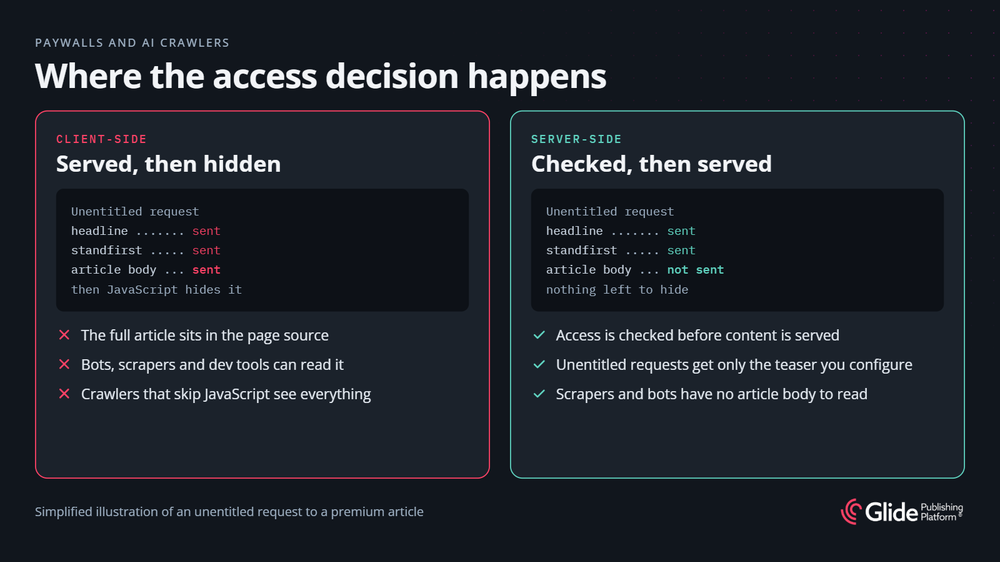
Client-side gating means the content travels from your server, through your CDN, into the browser, and then gets hidden by a script. The content has already been served, and anything that can read the raw HTML response (e.g. a bot, a scraper, or a browser extension) can often see the full article.
Server-side gating means the access decision happens before the content reaches the frontend. If the request isn't entitled, the protected content is stripped from the API response before it ever arrives at the browser. The response contains only what you've configured as the teaser: perhaps a headline, a standfirst, a preview paragraph, or whatever you choose.
In practice, this is what the difference looks like: an unentitled request to a premium article returns the headline and standfirst only. The article body is absent from the response entirely.
This is a fundamental architectural difference. Client-side protection hides content that's already been delivered, while server-side protection prevents delivery in the first place. Instead of more locks on the loaded security truck, you didn't send anything in the truck at all.
For publishers whose business model depends on content having genuine scarcity value, the difference us huge. A subscription is fundamentally devalued if it can be found elsewhere with ease, let alone the opportunity it presents to a direct rival to steal your info.
Three things have changed in the past couple of years which make server-side protection urgent rather than optional.
AI crawlers don’t execute JavaScript. They request publisher pages at scale and see whatever the server sends. If your paywall is client-side, your premium content is fully visible to every crawler that hits the page, and you're even paying the bandwidth to serve it all while receiving nothing in return. These automated requests don't execute JavaScript, never trigger an ad impression, and never trigger the paywall so if your premium content is in the HTML response, it's being served to machines at scale for free, including AI.
AI search products are summarising publisher content without sending users to the source. AI Overviews, Perplexity, ChatGPT et al answer user queries with publisher content, and referral traffic from these products is a fraction of what traditional search delivered. If protected content is never served to the frontend in the first place, it can't be summarised, quoted, or repurposed without a commercial agreement. All those AI products have a history of using content sourced without publisher permission, as well as mangling and ruining it to boot.
AI licensing is becoming a real revenue stream. Publishers are cutting eye-catching deals to license content to AI companies, but that licensing only works as a commercial negotiation if the content is genuinely protected. If it's already freely available in your HTML, there’s less leverage. Server-side protection creates something easier to put a value on: scarce access, which can be granted via a commercial API under whatever terms you set.
It's worth clearing up what server-side gating solves and what it doesn't. Most paywall platforms (such as dynamic paywalls, metered walls, or conversion-optimised overlays) focus on the conversion step: who sees the gate, what they see, what messaging drives them to subscribe. These tools optimise for the moments when a reader has to decide to pay.
Server-side gating solves a different problem: enforcement. Once you've decided content should be restricted, err... is it actually restricted? Can unauthorised requests, scrapers, bots, or someone inspecting the page access the content?
Publishers need both. A dynamic paywall that decides when to show the gate is more effective when the gate is real rather than cosmetic.
The conversion tool and the enforcement tool assist different parts of the same strategy. Server-side gating is the enforcement layer that makes everything above it more reliable.
Server-side control doesn't mean gating everything.
Publishers of course need some content to remain discoverable for better SEO, brand awareness, and audience acquisition. The answer is granular control: deciding in fine detail which content is fully open, which is teaser-only for unauthenticated requests, and which is completely restricted.
That granularity needs to work at the level publishers actually work at and think in terms of:
And all of this needs to be changeable without a developer ticket or a release cycle so commercial strategy remains unchained from engineering.
The ability to launch a new access bundle instantly, add or remove content from it without development or code, and adjust it based on performance, all turns content gating from a static infrastructure decision into a dynamic commercial tool. A commercial director can now create a new subscription tier, assign content to it by taxonomy or article type, launch it instantly, and adjust based on performance, all without waiting for a ticket or engineer.
That flexibility is what turns server-side gating from a security measure into a revenue aid. The granularity of what's protected and how it's bundled directly shapes subscription packaging, promotional offers, and content monetisation strategies. When launching or adjusting a bundle is a simple editorial decision rather than a multi-sprint development project, commercial teams can quite quickly experiment with pricing, packaging, and access models.
When content is gated server-side, the teaser becomes important because it's the only thing an unauthenticated request receives. It serves two distinct audiences with different needs.
For search and conversion: the teaser can give engines enough structured content to index and rank the page, while giving readers enough to understand the value of what's behind the gate. Configurable teasers (headline, standfirst, promo title) let publishers optimise for both simultaneously. The reader sees enough to want more, the crawler sees enough to index, and neither gets the full article without entitlement.
For AI licensing and commercial negotiation: server-side protection is what creates leverage. A publisher can offer AI companies structured access to full content via a commercial API or licensing agreement, while keeping the same content unavailable through standard web requests. When a publisher can demonstrate that their premium content is architecturally inaccessible without authorisation, they're selling access to something scarce rather than requesting payment for something already available. The protection is real, which means the negotiating position is real.
A common concern with server-side gating is whether it harms search visibility. The short answer: it doesn't, provided you implement Google's structured data requirements for paywalled content.
Publishers using server-side protection should mark up gated articles with isAccessibleForFree: false and use the hasPart property to indicate which sections are behind the paywall. This tells Google the content exists and should be indexed, while making clear that full access requires authentication. Google's own documentation confirms that properly marked-up paywalled content is not penalised in rankings.
The teaser content (headline, standfirst, and any preview paragraphs you configure) is what gets indexed and shown in search results. That teaser needs to contain enough substance to rank and enough relevance signals for the search engine to understand the article's topic. This is a content design decision, not a technical limitation.
CDN caching works normally with server-side gating. The gating layer sits between the content API and the frontend, making the access decision per-request based on the user's session or token. Cached teaser variants serve unauthenticated requests without hitting the origin, while authenticated requests are validated against the entitlements system. Latency impact is negligible because the entitlement check happens at the API layer before response assembly, not as an additional network hop.
Most publishers considering server-side gating already have identity management, a subscription system, and an existing paywall in place. Server-side entitlements don't replace these systems, they sit at the API response layer and enforce access decisions the rest of the stack defines.
The integration is quite straightforward: the gating layer intercepts content requests, validates the user's session or token against the publisher's existing entitlements system, and returns either the full content or, say, a teaser based on the result. The publisher's IDAM handles authentication, the entitlements system says what each user can access, and the gating layer enforces the rule before the response reaches the browser.
For technology leaders with existing infrastructure, this means server-side gating can be adopted without re-architecting the subscription stack. It's an enforcement layer added to the content delivery path, referencing the entitlements your existing systems already define.
This is the architecture we’ve implemented within Glide’s content delivery stack.
Glide Verify is a standard free feature within the CMS and acts as a filtering proxy between the CMS content API (called "Connect") and the front end, validating entitlements and stripping protected content at the API response level before it ever reaches a browser or bot.
Publishers configure gating rules from within the standard Glide CMS editorial interface with no developer input required. Content can be gated by taxonomy or article type, teaser presets are configured if wanted, and Access Bundles can be launched, adjusted, or expired without engineering involvement.
Glide Verify works in conjunction with existing IDAM, entitlements, and paywall providers; it doesn't replace them. Where Glide Nexa is deployed as an audience identity layer, Glide Verify consults user entitlements and subscription status in real time to determine what content the API should return, closing the loop between identity management and content enforcement without requiring a separate integration.
Enforcement depends only on the front end routing content requests through Verify rather than calling the Connect API directly. The architecture means protected content never appears in the API response for unauthenticated requests, giving publishers real protection when negotiating AI licensing agreements or defending the value of their subscriptions and content.
For publishers already running a conversion-focused paywall, Glide Verify adds the vital enforcement layer which turns a masquerade into real protection.
To explore how Glide Verify can protect your premium content at the server level, connect with a Glide product specialist.
Does server-side gating affect SEO? No, provided you implement Google's structured data requirements for paywalled content. Mark up gated articles with isAccessibleForFree: false and use the hasPart property to indicate protected sections. The teaser content (e.g. headline, standfirst, preview) still gets indexed and shown in search results. Google says that properly marked-up paywalled content is not penalised in rankings.
Can AI crawlers bypass a client-side paywall? Yes. AI crawlers (e.g. GPTBot, ClaudeBot, PerplexityBot, and others) request pages without executing JavaScript. A client-side paywall typically uses JavaScript to hide content after it loads, so any request that reads the raw HTML response can see the full article. Server-side gating prevents the content from being included in the response in the first place, making it invisible to crawlers regardless of whether they execute scripts.
What is a server-side entitlement? A server-side entitlement is an access decision made at the API or server level before content is delivered to the front end. The server checks whether the user has the rights to see a piece of content and includes or excludes it from the response accordingly. Stuff the user isn't entitled to see is stripped from the API response.
Does server-side gating add latency? Latency impact is negligible because the entitlement check happens at the API response layer as part of the normal content delivery process and does not add an additional network hop. For unauthenticated requests, cached teaser variants can be served directly from the CDN without hitting the origin server.
Can server-side gating work alongside an existing paywall? Yes. Server-side gating is an enforcement layer, not a replacement for conversion-focused paywalls. Your existing paywall continues to manage the conversion experience (who sees the gate, when, and what messaging they see), while server-side gating ensures any content behind that gate is genuinely inaccessible to anything that doesn't follow the proper authentication path.
Related articles:
No matter where you are on your CMS journey, we're here to help. Want more info or to see Glide Publishing Platform in action? We got you.
Book a demo
