 Products








Ready to get started?
No matter where you are on your CMS journey, we're here to help. Want more info or to see Glide Publishing Platform in action? We got you.
Book a demoMost publisher tech stacks have a CMS for content and an ad platform for revenue, but nothing connecting the two around a known reader. An audience identity layer fills that gap, turning anonymous sessions into addressable, first-party audience segments that serve editorial, commercial, and ad teams from a single profile.

Most publishers operate with two systems that never properly meet. On one side, the CMS: where content is created, structured, tagged, and published. On the other, the ad stack: where inventory is packaged, audiences are segmented, and revenue is generated. Between them sits a gap that costs real money every single day.
That gap is identity.
Without a reliable, persistent identity layer connecting the two, publishers are left stitching together fragmented signals from cookies, session data, and third-party trackers that are disappearing fast.
The result is familiar: ad teams build audience segments from incomplete data, while editorial trams publish content with no visibility into who consumed it and direct sales teams sell inventory on pageview metrics alone rather than verified audience depth.
Third-party cookies danced over this gap for years, allowing ad platforms to infer identity without publishers needing to build it themselves. As that era ends, the publishers who have already taken the step of knowing their readers through registration, login, preferences, and interactions on their own platforms are seeing the commercial difference clearly.
Authenticated, consented first-party audiences command meaningful CPM premiums over anonymous inventory. Industry benchmarks consistently show authenticated segments achieving 2-3x higher CPMs compared to cookie-based or anonymous equivalents, and that gap widens as a third-party signal quietly degrades. The publisher who can connect a newsletter subscriber to a site visitor to a paying member, and sell that unified profile to an advertiser with consent documentation, is selling something categorically different from a page impression.
Publishers who haven't built this layer are still selling content. The ones who have are selling an audience.
An identity layer sits between the CMS and every audience-facing system, including the aid stack. It provides a single user record that persists across sessions, devices, and channels, built from:
This is the layer that turns anonymous traffic into an addressable audience.
Once identity sits at the centre of the ad stack, the commercial model expands in three directions.
Direct sales - Ad sales teams gain something to put in a media kit beyond demographics and reach estimates. Verified, consented audiences segments, built on declared preferences and behavioural signals tied to known users, can be packages as premium audience products. A segment of readers who have saved three or more articles on a specific topic, hold on active subscription, and have visited at least twice in the past week is a materially different proposition from a contextual placement against content on that topic.
Programmatic yield - Authenticated user signals can be passed into Google Ad Manager and downstream programmatic systems as first-party audience data. Publishers with a functioning identity layer can activate these segments in Google Ad Manager's audience solutions, pass them to SSP's for deal ID targeting, and achieve higher floor prices on authenticated inventory than an anonymous supply. With Glide Nexa, the mechanics are straightforward: Nexa exports audience segments via REST API or structured data export (CSV, JSON, XLSX), and those segments feed into the ad serving layer directly.
Data clean rooms and second-party partnerships - Clean room compatibility is an active priority for enterprise ad sales teams. Google's PAIR protocol, LiveRamp's Clean Room, and similar environments allow publishers to match first-party audience data with advertiser CRM data in a privacy-safe environment, without either party exposing raw records. A publisher with a well-structured identity layer, with clear consent records and stable user IDs, is a viable clean room partner. Without it, they cannot participate meaningfully in these arrangements, which are increasingly where premium programmatic budgets are flowing. The same identity layer that informs ad targeting also powers paywall logic, newsletter personalisation, and content recommendations, so it represents one infrastructure investment rather than three separate ones.
For any commercial leader in the UK or EU, consent management is a precondition for everything described above. An audience segment that includes users without valid consent for ad targeting is a compliance liability, not a commercial asset. ICO enforcement and GDPR obligations mean the consent architecture of the identity layer matters as much as its segmentation capabilities.
A properly built identity layer handles consent captures at the point of registration and interaction, stores consent state per user and per purpose, supports consent versioning when purposes change, and prevents users without valid consent from being included in segments passed to ad systems. It should also support withdrawal, so that a user who revokes consent is removed from active segments in real time rather than at the next batch export.
Publishers who treat consent as an afterthought in their identity infrastructure will find their audience data commercially unusable in regulated markets, regardless of how well-structured the segmentation logic is.
Your CMS is built to handle content - articles, taxonomies, and publishing workflows - not audiences. Basic user management or registration forms bolted onto a CMS are typically disconnected from the ad stack, the newsletter platform, and every other audience touchpoint. Each system ends up with its own user database, and those databases don't talk to each other.
The identity layer needs to be purpose-built for audience interaction. It needs to handle authentication across multiple providers, track interactions at a granular level, manage entitlements and subscription stages, maintain consent records, and expose all of this so that downstream systems including the ad tech stack can consume it via stable APIs.
A publisher running a CMS for content, a newsletter platform for email, a commenting tool for community, and Google Ad Manager for monetisation without a clear identity layer has four separate audience databases, none of which reflect the full reader.
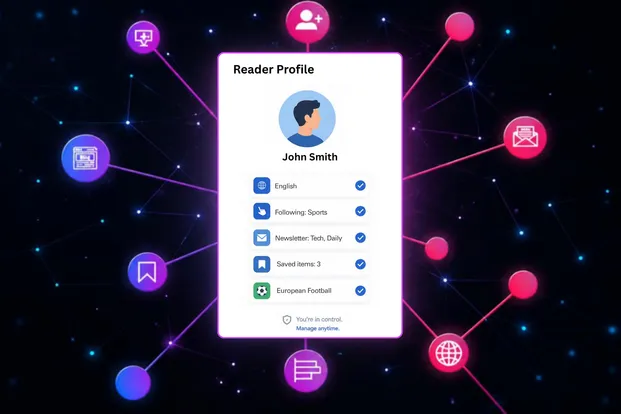
An identity layer connecting all four gives the publisher one unified audience. One reader who subscribes to the newsletters, comments on match reports, and visits three times per week, becomes one known user with a rich profile. That same profile informs which ads they see, which newsletter they receive, which content is recommended to them, and which audience segment they belong to in the ad server.
Most publishers already have a CMS, an ad stack, a newsletter tool, and a commenting system. Ripping everything out isn't realistic, and not necessary. The right identity layer works as a hub that connects to these existing systems via API, receiving interaction data from across the stack, attributing it to a single profile, and exposing segments so every connected tool can consume the same audience intelligence.
No single tool needs replacing. Each one gains access to richer data that it could build alone. As third-party signals degrade, advertisers are shifted budget toward authenticated, consented audiences, and the identity layer is what makes first-party data usable rather than siloed in systems that can't communicate.
Glide Nexa is an audience interaction platform built for exactly this purpose. It provides identity management, authentication (SSO, social sign-in, MFA), interaction tracking, entitlements, user preferences, groups, and segmentation, all one platform which sits between your CMS and every audience-facing system.
Its REST APIs allow newsletter platforms, commenting tools, ad systems, and analytics to read user data, write interaction events, and query audience segments. Each connected tool references Nexa's identity layer rather than maintaining its own database.
Audience segments built from the combined interaction data can be exported as CSV, JSON, or XLSX, or consumed directly via API by any downstream system including ad servers, DMPs, and SSPs. Consent state is stored per user and per purpose, with full audit history.
For publishers already running Glide CMS, Nexa integrates natively. For those on other CMS platforms, Nexa deploys standalone with no CMS dependency, connecting via API to whatever content and ad infrastructure is already in place.
To explore how Glide Nexa can provide the identity layer between your CMS and ad stack, connect with a Glide product specialist.
Related articles:
No matter where you are on your CMS journey, we're here to help. Want more info or to see Glide Publishing Platform in action? We got you.
Book a demo
