 Products







Ready to get started?
No matter where you are on your CMS journey, we're here to help. Want more info or to see Glide Publishing Platform in action? We got you.
Book a demoQuick-launch CMS platforms gate features behind pricing tiers, trapping publishers in systems they outgrow. Glide Go delivers full enterprise CMS capability from day one, no feature gating, no forced migrations.

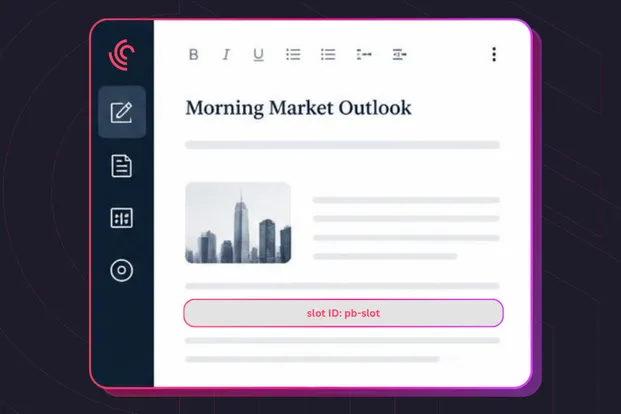
A CMS is the software behind a website and lets teams create, edit, and publish content on the site or other channels.
It's the tool journalists, editors, and marketers use to put articles, images, and pages live, and when a new site is starting out the appeal of the quick-launch CMS that packages hosting, templates, and publishing tools into a ready-made bundle so a team can go from nothing to a live website in days rather than weeks or longer.
Quick-launch CMS typically trade launch speed and simplicity for limitations. These platforms wrap the site and CMS into one and allow you to launch fast for relatively low upfront cost, with the acceptance that when you outgrow the "starter kit" you migrate to a fuller system.
Unfortunately, migrations can be serious and expensive undertakings, and what started out as a convenient decision becomes a permanent constraint.
Glide Go removes that trade-off by giving you a fully enterprise-level headless and API-first CMS from day one, which is as easy to onboard as a quick-launch CMS but able to grow without penalty.
The promise of a quick launch is quite appealing: pick a template, add some content, get going live in hours. For publishers testing new verticals or launching a niche brand, this speed is appealing and promises quick ROI.
The catch arrives later. Most such CMS gate any advanced capabilities behind pricing tiers or plan upgrades, limiting you to restricted features and pre-built templates until you pay for custom code injection, and higher pricing plans.
Feature gating shapes editorial and technical decisions long after launch.
When AI-assisted content tools are locked behind a higher tier, editorial teams develop workflows without them, spending more time on tasks that could be automated. When content gating capabilities aren't available until you upgrade, commercial teams delay subscription strategies that could generate revenue from day one. When API access is restricted, developers build workarounds rather than integrations, creating technical debt that makes eventual migration harder.
The most expensive outcome is the project that succeeds but can't capitalise on its success because the platform won't let it. A sports publisher launches a fan site on a basic platform, builds an engaged audience, then discovers they can't add live coverage, structured data, or premium content bundles without having to migrate to something else entirely.
And when that migration happens, the cost isn't just the new platform. There is also the content export, URL structures that don't carry over cleanly, the editorial team learning a new system while publishing daily, and the months of parallel running costs. For projects that took off quickly, the migration often takes longer than the original launch, and the total cost far exceeds what was saved at the start.
Glide Go is a turnkey deployment of Glide CMS with hosting, support, migration, and a pre-built front-end included. Nothing is gated so users enjoy the full capability set of Glide CMS from the first day of operation.
From day one, a Glide Go site has access to:
None of these features require an upgrade, an add-on purchase, or an enterprise commitment. They're included because gating them would create the exact problems that Glide Go is built to solve.
Glide Go is for publishers and media organisations who need launch speed but refuse to accept a capability ceiling:
If you're a publisher who needs to move fast but can’t afford to be hamstrung by feature gating, Glide Go is the platform which removes that trade-off.
Glide Go runs on MACH architecture. The back-end is the same CMS that powers enterprise customers, hosted on AWS as fully managed SaaS. Security patching, penetration testing, monitoring, updates, disaster recovery, and scaling are managed by Glide, with continuous platform upgrades delivered at no extra cost with a no-breaking-changes policy.
The front-end is flexible. Glide Go includes Glide Deliver, a free Next.js React-friendly starter pack compatible with Vercel, AWS Amplify, and Edgio. Use it as-is for speed, or replace it with a preferred framework, because the CMS is headless and the same REST APIs that power the editorial interface are available to external code with full read-write parity. Anything the editorial UI can do, code can do through the same endpoints.
Transmit, Glide's native pub/sub event bus, propagates every content event (publish, update, unpublish) in real time to any subscribed system. Integrations with analytics, CRMs, email platforms, and ad servers connect through standard webhooks and API calls rather than custom middleware. External data sources can be configured without code, giving editorial teams direct access to third-party APIs (sports data, financial feeds, reference databases) from within the CMS interface.
After launch, Glide delivers continuous updates at no extra cost, with proactive monitoring including cost anomaly detection. There's no plugin ecosystem to manage, no security patches to apply, and no version upgrades to schedule.
For developers, Go is an enterprise CMS with a very fast deployment model. The architecture is the same as examples running at scale for enterprise clients handling billions of pageviews. Glide Go removes the infrastructure setup time, but not the infrastructure capability.
When every capability is available from day one, the growth path changes fundamentally.
A team launching a new sports vertical can include live match coverage from the first event, gate premium analysis behind a subscription from launch week, use AI to generate translations as content volume grows, and connect to third-party data sources because all of it is already part of the platform. Nothing needs to be added through an upgrade, a migration, or a development project.
Because the architecture is headless and API-first, the same Go site can power multiple channels from a single content source. A web front-end, a mobile app, an Apple News feed, and a newsletter can all consume the same content through the Connect API without duplicating editorial effort or managing content across separate systems.
For teams with existing content on another platform, Go includes migration as part of the deployment package. For teams planning multiple brands, Go supports multi-tenancy with fully isolated environments per account and seamless switching between them.
This also opens the door for experimentation. When launching on a gated platform, teams have to predict which capabilities they'll need and budget for the appropriate tier in advance. With Go, the calculation is simpler: launch and use what you need. If the project succeeds and needs live coverage, it's there. If it pivots to a subscription model, the gating tools are configured. If it scales to multiple languages, AI translation is available.
Go and Glide's Private Cloud run the same CMS, the same content model, the same APIs, and the same editorial workflows. The difference is infrastructure isolation and scaling control.
When a Go project grows to the point where it needs dedicated infrastructure, the move is an infrastructure upgrade rather than a replatforming exercise. There's no data migration, no content export/import, no feature gap between what you had and what you're moving to, and no editorial disruption during the transition.
For technology leaders, this means you can approve a Go launch for a new project with confidence that success won't force a costly platform change later. The question is never "will we outgrow this?"; it’s simply "when do we want our own infrastructure?".
Ready to launch without the ceiling? Book a Glide Go demo to see how the platform works for your use case.
Related articles:
No matter where you are on your CMS journey, we're here to help. Want more info or to see Glide Publishing Platform in action? We got you.
Book a demo
