 Products






Ready to get started?
No matter where you are on your CMS journey, we're here to help. Want more info or to see Glide Publishing Platform in action? We got you.
Book a demoBook publishers are tying themselves in knots over alleged uses of AI in works. But what happens if the detectors are wrong or, perhaps worse, the AI stuff is better?
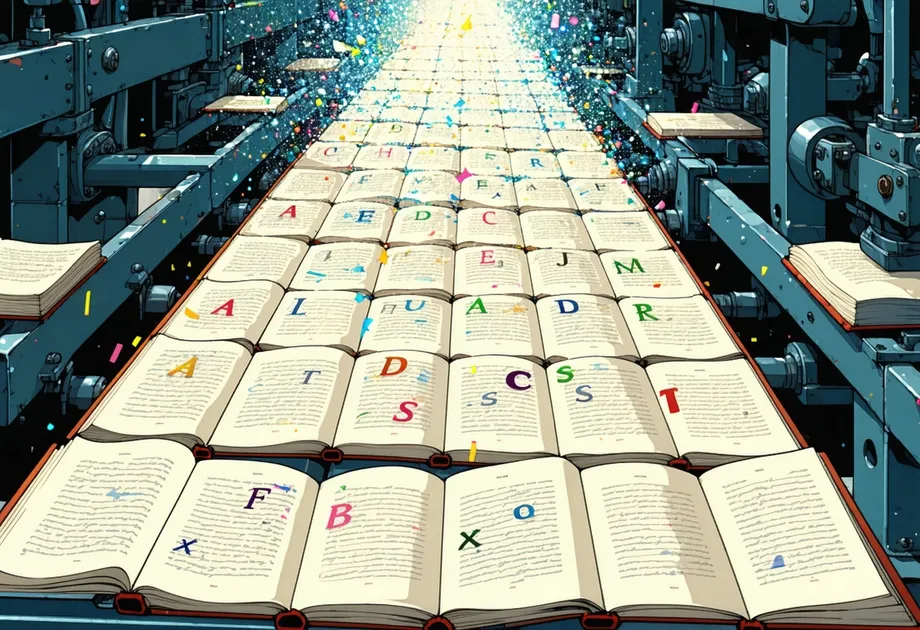
Rocked by a series of scandals and reputationally damaging allegations, some of our publishing cousins in the world of books aren't having a great time of it. The reason for all this tumult and rancour - which will come with as much surprise as the office printer having an ink issue - is AI.
Well, it isn't really AI, or at least that's how I consider it, clinging as I do to the idea that the technology itself is still blamelessly neutral, whatever the e-sentience hype merchants wish us to believe. It's not the AI, it's what people do with it. And what people have been doing with it is producing books, or parts of books, or paragraphs, or sentences, or meaning.
Books are obviously a less ephemeral proposition than most publishing of, say, news, sport, or entertainment. The physical and permanent nature of book publishing carries a certain gravitas for this reason, and so questions over the provenance of works marketed as "original" can erode trust in a book publisher in a very real way which can't be fixed the next day, unlike a website.
Some of the scandals have certainly been damaging. A recent Wall Street Journal write into the troubles besetting the book world detailed book launches suspended and authors under severe pressure to explain why their book has tested positive when run through an AI detection tool such as Pangram. We ourselves wrote about the unfortunate case of Steven Rosenbaum, who wrote a book about AI, using AI to produce some of the quotes he used which were then misattributed to real people.
Yet among all this doubt and concern, a quote stood out from one researcher uncovering such computer-generated deception. Professor Tuhin Chakrabarty, whose work led to questions about the best-selling book Daggermouth by H.M. Wolfe earlier this year, noted that the publisher, Simon & Schuster had stood behind the book and its author, who denied accusations of AI generation. "Why would Simon & Schuster drop it? Because apparently it already had a huge amount of success. So people were liking it," Chakrabarty told the WSJ.
In short then, if people liked the book, and liked it on its merits, then who cares how it came to be? If people like it, it's good enough, if they don't, it's not. These days, I can quickly discard a book if I find I don't like it by the first chapter, if not the first 10 pages. No one can gainsay your own quality control. Even if you're told something is good, maybe it just isn't for you.
Again, if you like it, why care how it was produced? This of course brings us to the idea of labelling content that has had AI used at some point in its production, a notion with currency in our industry. There seems to be little objective logic in doing so. If you are using AI and your stuff is not good enough, then you might as well be publishing into a disused coal mine.
One publishing outfit this week announced they were taking a different approach, and it bears the hearing. Jeff Hayward of Ai-Ai-OH has said they will no longer query the use of AI in submissions to them, and instead will simply focus on whether the content is good or not, and whether it shows effort or not, effort in this case being as simple as reading the submission guidelines properly.
Hayward also casts doubt on the efficacy of systems such as Pangram, recently introduced into Substack as a sort of authenticity authenticator, ultimately on the grounds that it's just a machine checking for the work of machines, which is anyway based on the still-common writing patterns of humans. As he puts it, "We’re not 'giving up,' we’re accepting the reality that AI can fool even us, but it can’t necessarily meet our quality bar."
Quality sufficient for the purpose of the content is all that matters. And if you're like me, and believe that while full of utility, AI has almost zero truly creative ability, then the lofty peaks of literary endeavour will remain safe from its synthetic footprints.
None of this negates a central truth, that the data used to train such systems does indeed have a provenance, and the originators of that harvested data are still by and large not compensated for its ingestion into the eventual coffers of Big AI, or even small AI. Maybe every piece of content which has used AI in its creation should carry a "May contain traces of Stephen King" label?
There is also a broader cultural consideration here. Is there the possibility that the sheer volume of content that AI is capable of producing, regardless of any quality consideration, overwhelms humanity's ability to discern the good from the bad, and accustoms us to consuming absolute dross to the extent that we collectively forget what good actually looks like?
I don't think so. But a label won't help either.
No matter where you are on your CMS journey, we're here to help. Want more info or to see Glide Publishing Platform in action? We got you.
Book a demo
