 Products






Ready to get started?
No matter where you are on your CMS journey, we're here to help. Want more info or to see Glide Publishing Platform in action? We got you.
Book a demoOne scientific publisher saw 5.7 billion bot requests in 16 days, and an AI site scraped a drug formulary and recommended a fatal child dosage. Two trust-critical brands discuss where AI helps, where it harms, and where it cannot be used.
"We co-publish a formulary used by pharmacists to determine dosages. An AI-driven site scraped it and recommend an adult dosage to a child, which would have been fatal."
That quote reflects the tone for what happens when AI meets content where accuracy is life-or-death.
In this fascinating talk the discussion centred on actually using AI in an environment where trust is critical, and where it is NOT being used. It also touched on the tactics publishers are being forced to take when their content is taken by AI companies and at times muddled or misattributed with potentially deadly effects.
A consumer trust brand (subscription-funded, no advertising, tests thousands of products per year) and a scientific publisher (65+ journals, content influences clinical guidelines globally) shared their approaches to AI - where it helps, where it cannot be used, and how to draw lines that hold.
The unifying principle: AI is a tool, not a decision-maker and human-in-the-loop is non-negotiable. But the panel also argued that the biggest risk most publishers face is under-investment, not over-investment.
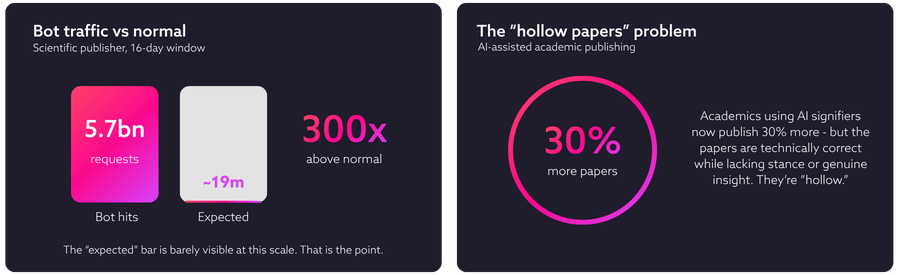
One scientific publisher recorded 5.7 billion bot requests in a 16-day window, approximately 300x normal traffic levels. This isn't background noise. It's industrial-scale extraction of content that influences clinical guidelines.
50% of consumers prefer brands that avoid GenAI in consumer-facing content. Even if publishers could guarantee zero errors, consumer resentment may constrain what's possible. Source: Gartner, March 2026
Stat: Bot traffic vs normal (scientific publisher, 16-day window):
The "hollow papers" problem: For one publisher, academics using AI signifiers now publish 30% more papers compared to those who do not: the work is technically correct, but they feel lacking in stance or genuine insight. The output is "hollow" - accurate but purposeless. This same risk applies to any publisher that uses AI for content creation without editorial judgement layered on top. Broadly, AI content comes across more neutered than neutral.
"Code is no longer a moat. The moat is unique data, clean data, understood data, and trust and brand."
A human-curated knowledge graph is being licensed to third parties precisely because it's guaranteed AI-free. Trust has become a licensable product in itself. One licensing deal mentioned in the room involves a major tech company using publisher knowledge to power health recommendations.
AI use discussed in this session was organised into four tiers:
A consumer-facing chatbot was deliberately launched with a very narrow scope, giving product recommendations only, not "ask us anything." Scope management controls cost and risk. Token monitoring from day one. LLM-model-agnostic approach across multiple providers.
AI rollout is a people problem rather than a technology one. Existing AI tools can do sophisticated things today, but the bottleneck is building human confidence in the output, both internally and externally among your audiences.
Tracking whether adoption is genuinely useful regardless of what people say about the technology is not easy. One staff adoption metric was: "If we took away the AI tools tomorrow, how upset would people be?".
Internal tools that surface insights are only as good as the clean data beneath them. One organisation built an analytics tool in half a day - but can't release it widely because the underlying data tagging isn't clean enough. Tacit organisational knowledge doesn't transfer automatically.
An AI peer review assistant can extract every statistical claim from a research paper and re-check whether the evidence supports the conclusions. Still in proof of concept condition - editors require evidence equivalent to a randomised controlled trial before trusting it.
"AI is confidently wrong. Lots of people are beginning to look at content which isn't very good. One trend we might see is a return to trusted media because the generative sources will be incorrect."
"We found a website that is a complete rip-off of our site with our branding. Our Head of Research Integrity's profile is on there talking about the high research integrity of the site. It's nuts."
"The papers are technically correct, accurate, but they don't have a stance in the world. They don't really have any position. They're hollow."
"You can't take the stance of banning AI use. A controlled study showed reviewers who pledged not to use AI used it anyway."
"50% of consumers prefer brands that avoid GenAI in consumer-facing content. Even if you could guarantee zero errors, does that consumer resentment constrain what you can do?"
More from Glide Live: London 2026
Glide Live operates under Chatham House Rules. No speakers or organisations are identified in these summaries unless specifically requested or authorised.
No matter where you are on your CMS journey, we're here to help. Want more info or to see Glide Publishing Platform in action? We got you.
Book a demo
