 Products






Ready to get started?
No matter where you are on your CMS journey, we're here to help. Want more info or to see Glide Publishing Platform in action? We got you.
Book a demoTaxonomy-driven distribution, configurable sending preferences, and Glide Nexa-powered delivery let editorial teams target segmented audiences from a single workflow without duplicating content.
Most publishing teams treat email briefings and website content as separate workflows. The CMS handles articles while a newsletter tool - such as Mailchimp, Campaign Monitor, Sailthru, or similar - handles distribution. Between the two sits a gap filled with manual effort: copying content from one system, pasting it into another, reformatting it for email, selecting the right audience list, and hoping the send goes out on time.
For teams producing a single weekly newsletter, this is manageable. For operations sending multiple daily briefings to different subscriber segments across different brands - each with different sender addresses, schedules, and audience criteria - the gap becomes a workflow bottleneck. The editorial team spends time on distribution mechanics instead of content. The subscriber data lives in one system while the content lives in another, and the two never quite stay in sync.
The alternative is to make the CMS the single point of creation and distribution so editors write, target, and send from one place, without maintaining a parallel system for email delivery. This is exactly what Glide CMS became for one global financial markets data provider.
Their editorial teams produce daily briefings, market analysis, and in-depth reporting across multiple specialist brands, serving thousands of financial professionals worldwide. The time-sensitivity of financial markets means briefings need to reach the right subscribers within minutes of publication, and the editorial teams produce dozens of these daily across regional and thematic products.
The requirement: let editors write once, target specific subscriber groups with precision, and control sending preferences at a granular level, all while maintaining the speed that financial markets reporting demands.
Editors write, format, and send briefings from the same interface they use for all other content without having to switch between a separate email platform or having to copy text between systems. The workflow supports three distinct patterns depending on the content type:
A fourth pattern, newsletter briefings, a dedicated newsletter article type that combines curated links, editorial commentary, and custom sections into a single send is available for teams that need a lighter-weight format that’s useful for roundups, digests, or link-driven communications that don’t require full article pages on the website.
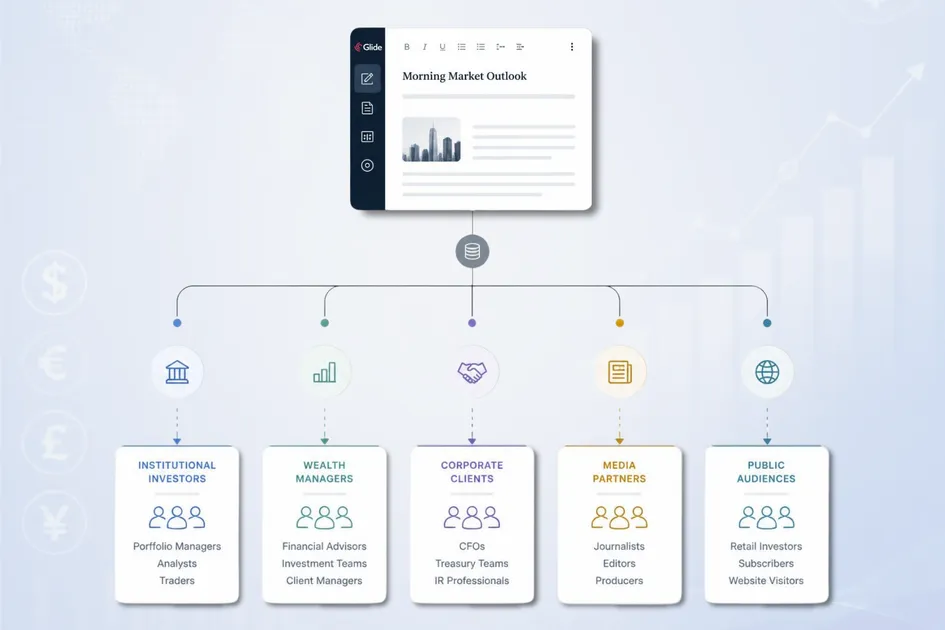
The entire distribution model is taxonomy-based. Each briefing list is represented as a Glide taxonomy connected to its corresponding subscriber group in Nexa. When an editor attaches a taxonomy to an article, they’re selecting the audience, no technical configuration required.
Because targeting is handled through taxonomy assignment, editors can control distribution directly from the article as follows:
Article-level controls give editors additional flexibility over how each piece is distributed:
Together, taxonomies handle who gets what, while article-level settings handle how it’s delivered. The model is flexible enough that one article can serve multiple distribution channels simultaneously without duplication.
For a deeper look at how structured taxonomies power content routing and audience targeting in Glide CMS, read Why hierarchical taxonomies outclass free-form tagging in your CMS.
Each briefing taxonomy carries custom fields that control how emails are sent:
Operational teams configure sending behaviour through the CMS interface. When a new briefing product launches, the configuration is a taxonomy setup task rather than a development project. Every briefing send is campaign-tracked automatically - tagged by brand, briefing type, date, and product - giving operations teams deliverability and engagement analytics without manual tagging or UTM configuration.
The financial data provider's editorial teams produce magazine briefings that compile multiple articles into a single edition. Not every subscriber has the same access tier, some hold full subscriptions while others are limited to specific product areas.
Rather than creating separate editions for each tier or relying on editors to manually segment their audience, Nexa resolves entitlements at send time. When a magazine briefing is triggered, each subscriber's access is checked against every article in the compilation. A subscriber whose tier doesn't cover a particular article simply doesn't receive it in their email. Two readers on the same briefing list may get different article sets from the same edition, based on what their subscription permits.
For editorial teams producing dozens of daily briefings across specialist products, this means editors don't need to think about who can see what. They curate the edition once.
Glide Nexa acts as the subscriber identity and targeting layer. It manages subscriber groups - mapping each briefing taxonomy to a defined audience - and stores the sending preferences (sender address, display name, reply-to, schedule) that editors configure through the CMS.
When an editor publishes a briefing, Glide CMS triggers a delivery workflow that resolves which subscriber group corresponds to the attached taxonomy via Nexa, retrieves the recipient list, checks each user's subscription status, and sends the email. This is the entitlement logic described above.
The editorial team doesn't interact with Nexa directly during day-to-day production. The targeting decision is made by selecting a taxonomy, the same action they'd take to categorise an article for the website. Nexa resolves the audience without editors needing to leave Glide.
A new briefing product is a configuration task (taxonomy + subscriber group + sending preferences), not a development project or a new tool to learn.
Because Nexa manages subscriber identity, entitlements, and group memberships, the same platform that handles targeting also knows which users hold premium subscriptions, which topics they follow, and how they engage with content. That data can shape decisions about which briefings to launch and how to segment audiences further, without exporting anything to a separate analytics or CRM tool.
This workflow demonstrates how Glide CMS and Nexa together deliver a fully integrated editorial and distribution system. The financial data provider runs four distinct properties on Glide CMS and Nexa from a single deployment, each with independent sending identities, subscriber groups, and content entitlements.
By creating briefings natively in Glide and using taxonomy-driven sending through Nexa, editorial teams across all four properties maintain full control over content creation, audience targeting, and delivery timing without leaving the CMS.
For organisations producing high-frequency subscriber content across multiple brands and audience segments, the same pattern applies regardless of whether the content is financial analysis, sports coverage, or news briefings.
To see how Glide CMS and Nexa can support your briefing and newsletter workflow, connect with a Glide product specialist.
Related articles:
No matter where you are on your CMS journey, we're here to help. Want more info or to see Glide Publishing Platform in action? We got you.
Book a demo
