 Products








Ready to get started?
No matter where you are on your CMS journey, we're here to help. Want more info or to see Glide Publishing Platform in action? We got you.
Book a demoZero-party data, the preferences readers declare on purpose, is more accurate, more durable, and more valuable than anything you infer from their behaviour. Here's why it beats guesswork, and why it matters more as cookies disappear.

Personalizing content and information has always been a key task of a content or marketing team, well before digital media and recommendation engines existed. Editors would choose what stories to lead a page or section, using gut feel and sales figures to make judgment calls, while marketing teams used signals like demographic data and response data to estimate what would work best where. Over time, even without knowing a single reader's name, good editors and marketing teams built up a feel for what would work based on the aggregate of what they could see or measure.
Digital media sent that into overdrive, allowing site owners to track patterns and journeys and build a compelling picture of what people liked based on inferences alone. Clicks, device types, and dwell time started to usurp individual judgment, and cumulatively a new set of rules dominated, but still without knowing who the reader is or what they actually like.
But both models have something missing: actual insight from real people on what they do and do not like. And because of that reliance on educated guesswork, the value of the inferred data is far lower, both in terms of making confident decisions about content and campaigns, and from a commercial standpoint too.
As search and recommendation algorithms on the distribution side advance, inferred preferences on the publishing and media side has diminished in value and effect. It’s a scenario being made worse by changing regulations around tracking and what information a cookie can store.
There is a simpler model. Ask them. Ask readers what they care about, remember what they tell you, and use that to shape their experience. This is zero-party data (also called declared data), the signals a reader actively provides, rather than signals extracted from their behaviour without their awareness. It is the foundation of preference-based personalization, and of how you build an audience you actually own.
Zero-party data has one defining quality: the reader chose to give it to you. That is what separates it from inferred data, which comes from observing behavior and drawing conclusions, not something a reader knowingly hands over to you. A reader visits three baseball articles, so the system infers they like baseball. They spend four minutes on a long-form analysis piece, so the system infers they prefer in-depth content. They visit at 7am on weekdays, so the system infers they are a morning reader.
Each inference is a probability, not a fact. The reader might have clicked those sports articles because they were on the homepage, not because sports is their primary interest. The four-minute session might have been an idle tab. The morning visits might be a temporary pattern during a commute that changed last week.
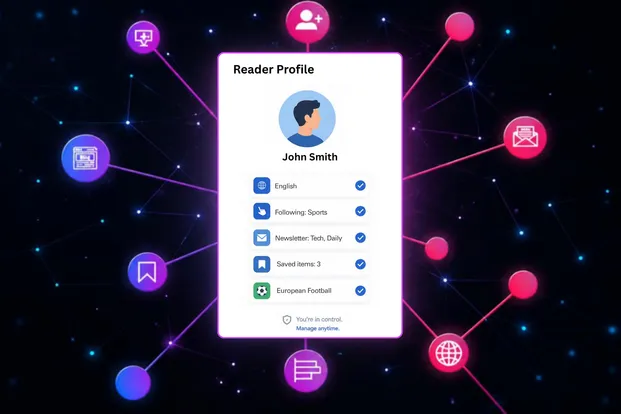
Zero-data party data is more useful because it comes from the reader directly, giving genuine signals about what they like:
These are statements of intent from the reader, not guesses. Following a topic says "I want more of this", saving an article says "this has lasting value to me", and picking a newsletter chooses a relationship with a specific content area.
The practical machinery of inferred personalization depends on persistent tracking. You need to recognize the same person across sessions, accumulate their behavior into a profile, and feed the profile into a recommendation engine.
Third-party cookies made this relatively straightforward for years. They are now disappearing, and browser privacy features are becoming more restrictive. Platform policies limit cross-site tracking. GDPR and similar regulations require explicit consent for the kind of tracking that inference relies on, and consent rates for tracking are consistently low.
Inferred personalization systems now work with less data, shorter histories, and more fragmented signals than they were designed for. Recommendations get worse and the gap between what readers want and what the system guesses widens.
Where inference depends on tracking that is disappearing, zero-party data has none of these dependenceis. A reader who follows a topic does not need a cookie for that preference to persist. It is stored against their authenticated profile and remains valid until they change it. No browser policy, platform decision, or regulatory change can erode it.
Zero-party data is not just more accurate, it's more valuable.
On the commercial side, advertisers value it because it's specific, consented and verifiable. A segment such as "declared Premier League football fans who engage with prediction content weekly" is built entirely from stated behaviour. It does not rely on probabilistic modelling or cookie-based inference, which means it survives every privacy change intact, the kind of signal you can turn into sellable audience segments.
Zero-party data also has a better legal basis. A reader who actively follows a topic is providing information voluntarily, stored on your own platform and used with their explicit awareness. There is no ambiguity about consent and no risk that a regulatory change invalidates how you collected it.
This is not an arguement for abandoning behavioral signals. Reading frequency, session depth, and content consumption patterns remain useful context, and what people say they like and what their patterns suggest they like are not always the same. Inference also drives discovery: it can surface something inferred data heavily suggests a reader would enjoy but has not thought to follow, which zero-party data alone can never do. But zero-party data should be the foundation, supplemented by inferred signals, not the other way around.
The difference is what happens when part of the signal disappears. If browser changes break session tracking the zero-party data remains. If a reader clears their history or uses a different browser, their follows, saves, and newsletter selections are still intact. Zero-party data is resilient in a way inferred data is not.
Knowing zero-party data is better is one thing; collecting and acting on it is another. It works best when it is gathered gradually, at moments where stating a preference clearly benefits the reder, and when eveyr declaration earns something back: a better feed, a relevant newsletter, a reding list worth returning to. That fair value exhange is what keeps readers declaring more over time.
Making it useful then depends on tying every follow, save, poll response, and newsletter choice to a single known proifle, so preferences do not end up scattered across separate systems. That is where a platform built for the job comes in.
Glide Nexa is built on this principle. It stores every declared signal against one authenticated profile and turns it into targeting you can act on, without depending on the tracking that inference runs on.
Our companion guide, Preference-based personalization with Glide Nexa: how it collects and uses zero-party data, walks through exactly how that works, from the follow button to advertiser-ready segments.
What is zero-party data? Zero-party data is information a reader shares intentionlly, such as a followed topic, a saved article, or a chosen newsletter. It is also called declared data. Unlike inferred data, which is guessed from behaviour, zero-party data is stated outright by the reader and stored against their profile, which makes it more accurate and more durable.
What is the difference between declared data and zero-party data? They describe the same thing. Zero-party data is the term that has become common in marketing and martech, while declared data is the plainer description. Both mean information a reader shares intentionally, such as a followed topic or a newsletter choice, rather than data inferred from behavior.
Is zero-party data the same as first-party data? Not quite. First-party data usually refers to behavior you observe on your own platform, such as which articles a reader opens. Zero-party data is what the reader says directly. Both are collected on your own platform and owned by you, but zero-party data carries clearer intent and a cleaner consent basis.
Does preference-based personalization replace behavioral tracking? No. Behavioral signals still add useful context. The point is to make declared data the foundation and let behavioral signals supplement it, rather than building personalization on inference alone.
What happens to zero-party data when cookies disappear? Nothing. Zero-party data is stored against an authenticated profile, not a browser cookie. It persists through browser changes, cleared histories, and device switches, which is what makes them more durable than inferred signals.
Related articles:
No matter where you are on your CMS journey, we're here to help. Want more info or to see Glide Publishing Platform in action? We got you.
Book a demo
