 Products







Ready to get started?
No matter where you are on your CMS journey, we're here to help. Want more info or to see Glide Publishing Platform in action? We got you.
Book a demo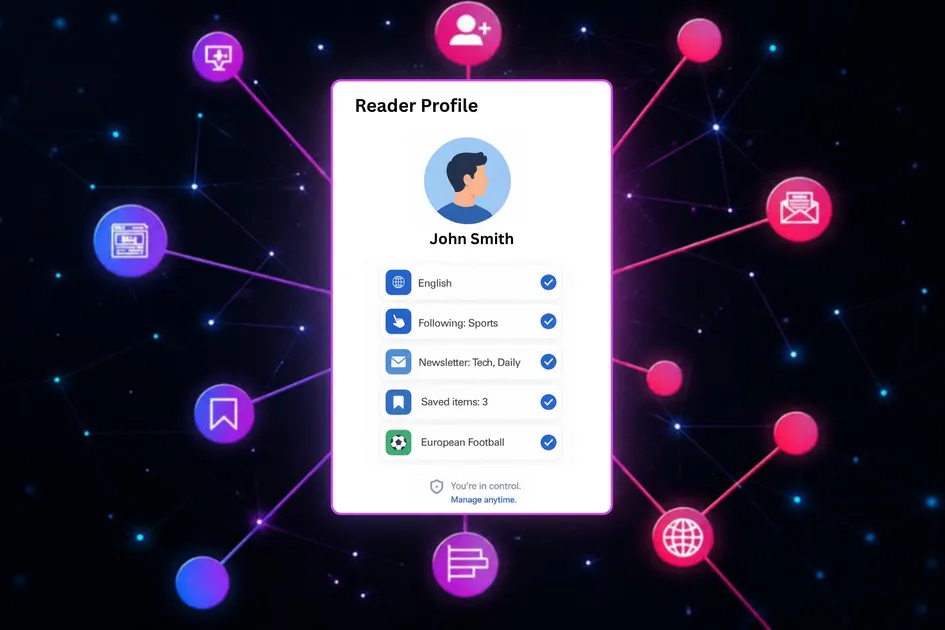
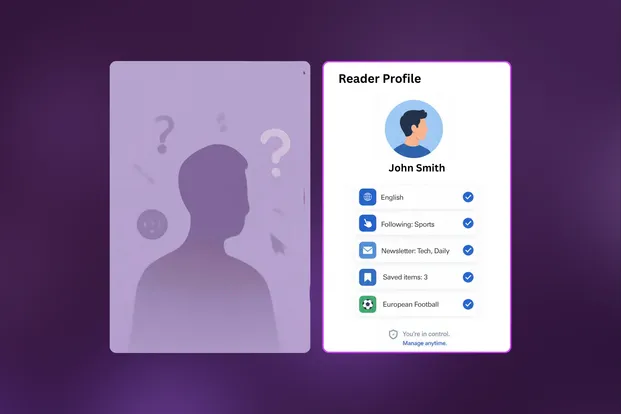
Most personalization runs on inference: clicks, dwell time, and device patterns fed into a recommendation engine. It's guesswork, and it's getting harder to sustain as third-party cookies disapper and privacy regulations tighten. There is a more reliable foundation, the preferences readers declare on purpose, known as zero-party data.
This guide is about the practical side: how Glide Nexa captures that zero-party data through a reader's normal interactions, stores it against a single known profile, and turns it into content targeting, campaigns, and advertiser-ready segments.
For the full case on why declared preferences beat inferred guesswork, start with our companion guide: what zero-party data is and why it beats inference.
In Glide Nexa, zero-party data accumulates through a reader's normal interactions with a site. Each interaction is recorded with its type, intent, timestamp, and the content item it relates to. The key sources are:
Topic and author follows
Readers choose which subjects and writers they want to see more of. This is the most direct form of declared preference, requiring no interpretation and no decay model. If someone follows "European football" today, that preference is valid until they unfollow it.
Saved articles and bookmarks
When a reader saves content, they are curating their own collection. The topics, formats, and authors in that collection are themselves a declared signal of what the reader values.
Poll responses
When a reader votes in a prediction poll about a specific team, or answers a survey about their content preferences, they are providing declared interest data. Nexa records which users participate, how often, and what subjects their responses relate to.
Custom interactions
Site owners can define custom interaction types beyond the standard set. A sports organization might track "favorite team" as a declared field. A financial media brand might capture "companies of interest". These are explicit, configurable data points chosen by the organization and provided by the reader.
Group memberships
Readers can belong to groups representing interests, loyalty ties, or community affiliations. Whether self-selected (joining a fan group) or earned (reaching an engagement threshold), group membership is a clear, actionable signal.
The mechanics are deliberately light. A reader taps follow on an author's page, and their next visit surfaces more of that author's work. They pick the technology newsletter at sign-up, and that is the edition they receive. Each action is a single tap that pays the reader back immediately, which is what keeps them declaring more over time.
Declared preferences become useful when they feed back into the reader's experiences.
A reader who follows three topics and two authors has told you precisely what their ideal homepage looks like. Content matching those follows can be prioritized in feeds, section pages, or personalized recommendation modules. The confidence level is high because the reader explicitly chose those preferences.
Newsletter editions, push notifications, and email campaigns can be targeted on declared interests rather than inferred segments. A reader who selected the "Technology" newsletter and follows the "AI" topic receives the AI-specific newsletter edition. No inference required, no risk of irrelevance.
Nexa's poll targeting connects directly to zero-party data. A poll about premium content satisfaction appears only to users with active premium subscriptions. A sponsor-branded prediction poll targets users in a specific geographic region who follow a particular sport. The targeting rules reference what Nexa already knows from declared preferences, entitlements, and group memberships, and combine them with AND logic.
On the commercial side, advertisers value zero-party data because it is specific, consented, and verifiable. A segment such as "declared Premier League football fans who engage with prediction content weekly" is built entirely from declared behavior. It does not rely on probabilistic modelling or cookie-based inference, which means it survives every privacy change intact.
The most common mistake is asking for too much, too soon. A long sign-up form demanding age, location, job title, and interests before a reader has seen any value kills conversion. Zero-party data works best when it is collected gradually, at moments where stating a preference clearly benefits the reader.
Topic and author follows are the easiest starting point. A "follow" button on an article or author page asks for nothing except a tap, and the payoff is obvious: more of what the reader just chose. Newsletter selection is a close second, because the reader is already opting into a relationship and choosing a subject area is a natural part of that.
From there, preferences can deepen over time. A reader who follows three topics might later set a content language, mute a subject they are tired of, or answer a one-question poll about what they want to see more of. Each step is small and optional, tied to a clear benefit. The profile builds itself through use rather than through a single demanding form.
The principle is a fair value exchange. Every time you ask a reader to declare something, they should get something back: a better feed, a relevant newsletter, a saved reading list they can return to. When the exchange is fair, readers keep declaring, and the profile keeps improving.
Glide Nexa stores all zero-party data against a single authenticated user profile. Every follow, save, poll response, newsletter selection, and custom field value builds up with every interaction into a profile that improves over time.
The platform captures each interaction in real time, with its type, intent, timestamp, and the content item it relates to. Engagement analytics are generated automatically: weekly and monthly snapshots, breakdowns by interaction type, time-of-day patterns, and per-user activity summaries.
Because Nexa is the identity hub connecting newsletters, commenting, polls, and subscription services, the zero-party data from every touchpoint flows into the same profile. Email platforms pull identity and preferences from Nexa. Commenting systems tie posts to known users, poll participation logs against real people, and you get a consolidated picture rather than fragmented preferences scattered across separate systems.
Why this matters in practice: because every signal sits against one profile that a browser change or cleared cookie cannot erase, the personalization built on it keeps working. Targeting stays accurate, segments stay sellable, and the audience relationship stays yours rather than rented from a platform that can change the rules. It is also less demanding on your own systems than a recommendation engine trained on behavioral inference, because the reader does the work of telling you what they want.
Preference-based personalization does not mean abandoning behavioral signals. Reading frequency, session depth, and consumption patterns remain useful context, and inference still drives discovery, surfacing something a reader would likely enjoy but has not thought to follow. The difference in Nexa is that both live against the same authenticated profile, with zero-party data as the foundation and behavioral signals supplementing it.
That also makes the profile resilient. If browser changes break session tracking, or a reader clears their history or switches device, their follows, saves, and newsletter selections are still intact in Nexa. The declared layer persists where the inferred layer does not.
(For the full explanation of why declared data outlasts inference, and its commercial and GDPR advantages, see the companion guide: "what zero-party data is and why it beats inference".)
For organizations already using Glide CMS, Nexa integrates natively. For those on other platforms, Nexa deploys standalone and connects via API. The zero-party data it collects is first-party, fully owned by you, and available to any connected system through REST APIs or structured data exports.
Personalization built on what readers tell you, rather than what you guess about them, is more accurate and longer-lasting, and it keeps working through the privacy and browser changes that erode inference.
To explore how Glide Nexa can support preference-based personalization and zero-party data for your audience, connect with a Glide product specialist.
How does Glide Nexa collect zero-party data? Through a reader's normal interactions: following topics and authors, saving articles, choosing newsletters, voting in polls, joining groups, setting a content language, or filling a custom preference field. Each action is recorded against the reader's authenticated profile with its type, intent, timestamp, and related content item.
What is preference-based personalization? It is personalization built primarily on preferences readers declare themselves (zero-party data) rather than on behavior inferred from tracking. Glide Nexa uses those declared signals to prioritize content, target newsletters and campaigns, and build audience segments.
Does Glide Nexa still use behavioral data? Yes. Behavioral signals add useful context and drive discovery. Nexa keeps them against the same profile as the declared data, with zero-party data as the foundation and inference supplementing it.
Do I need Glide CMS to use Nexa? No. Nexa integrates natively with Glide CMS, but it can also deploy standalone and connect to other platforms via API. The data it collects is first-party and fully owned by you, accessible through REST APIs or structured exports.
How does zero-party data help with advertising? It produces segments that are specific, consented, and verifiable, for example "declared Premier League fans who engage with prediction content weekly". Because these are built from declared signals rather than cookie-based inference, they remain usable through privacy and browser changes.
No matter where you are on your CMS journey, we're here to help. Want more info or to see Glide Publishing Platform in action? We got you.
Book a demo
